How to Check if a Company Is Legit: 30 Business Records Tested
We picked 30 active companies from three state registries and ran the same check on each. Seven had been dissolved before. Here is what to look at beyond 'Active'.
By Muhammet Dikyurt Published
Before you send a deposit to a roofer or a plumber, the usual advice is to research the company you are about to pay and look it up in the state’s business registry. Search for the company on the state portal. Find its record. If it says “Active,” you’re fine.
We wanted to see how much that check is worth in practice, so we picked 30 active companies from the official registries of three states and ran the same check on each one. What does the record show? Does the company’s website match the record? And what is behind a record that shows as “Active”?
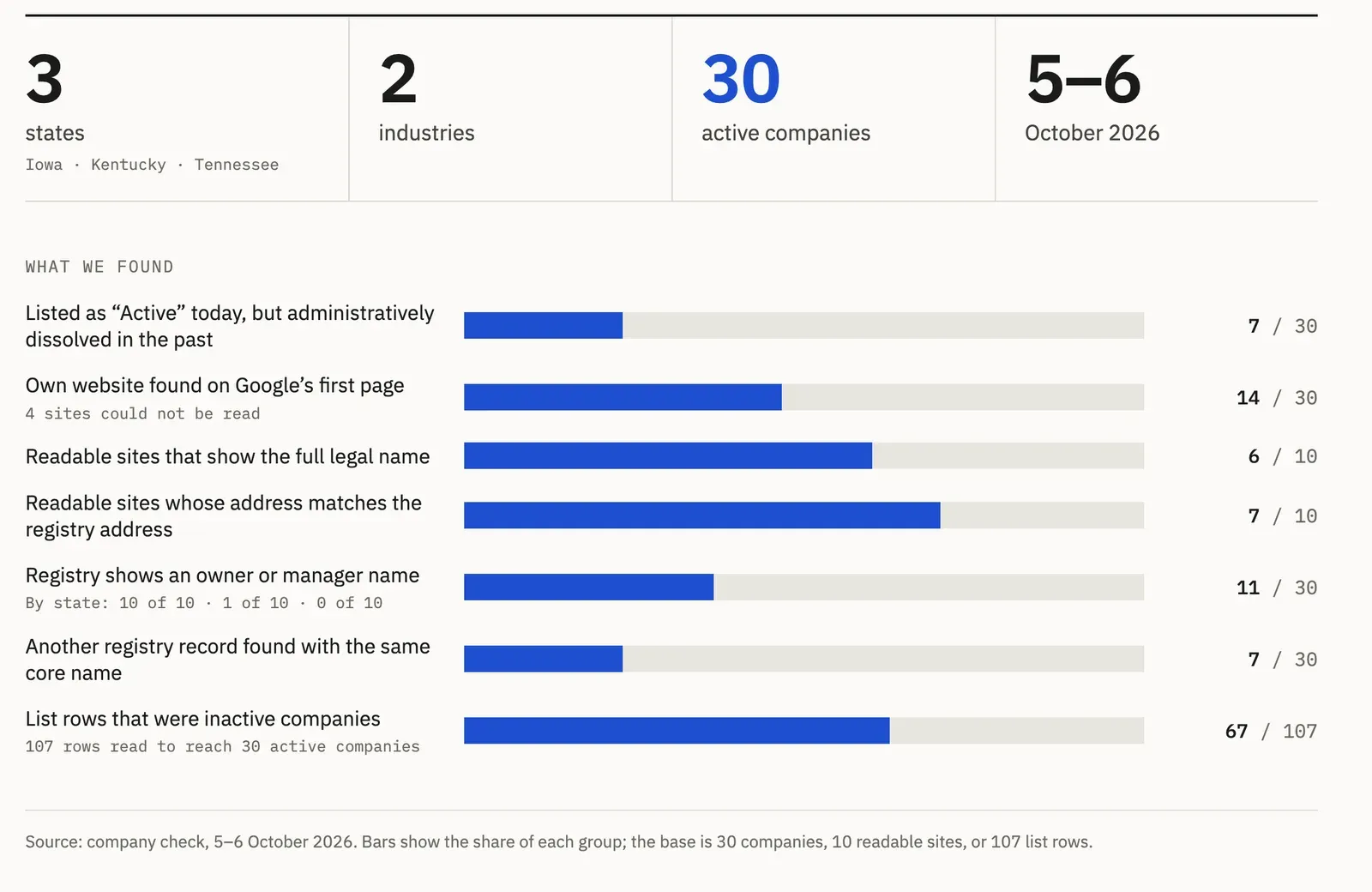
What we found
| What we looked at | Result |
|---|---|
| Companies showing as “Active” today with an administrative dissolution in their history | 7 of 30 |
| Companies whose own website we could find on Google’s first page | 14 of 30 (4 of those sites could not be read) |
| Websites we read that give the full legal name | 6 of 10 |
| Websites whose address is the same as the address in the record | 7 of 10 |
| Records that show the name of an owner or manager | 11 of 30; by state, 10 of 10, 1 of 10, and 0 of 10 |
| Companies with another record in the registry under the same core name | 7 of 30 |
| List rows we read to reach 30 active companies | 107; 67 of them were inactive companies |
Thirty companies is a small sample, and it covers only three states and two lines of work. The numbers hold for these 30 companies. The method and its limits are at the end of the page.
The “Active” label does not show the company’s history
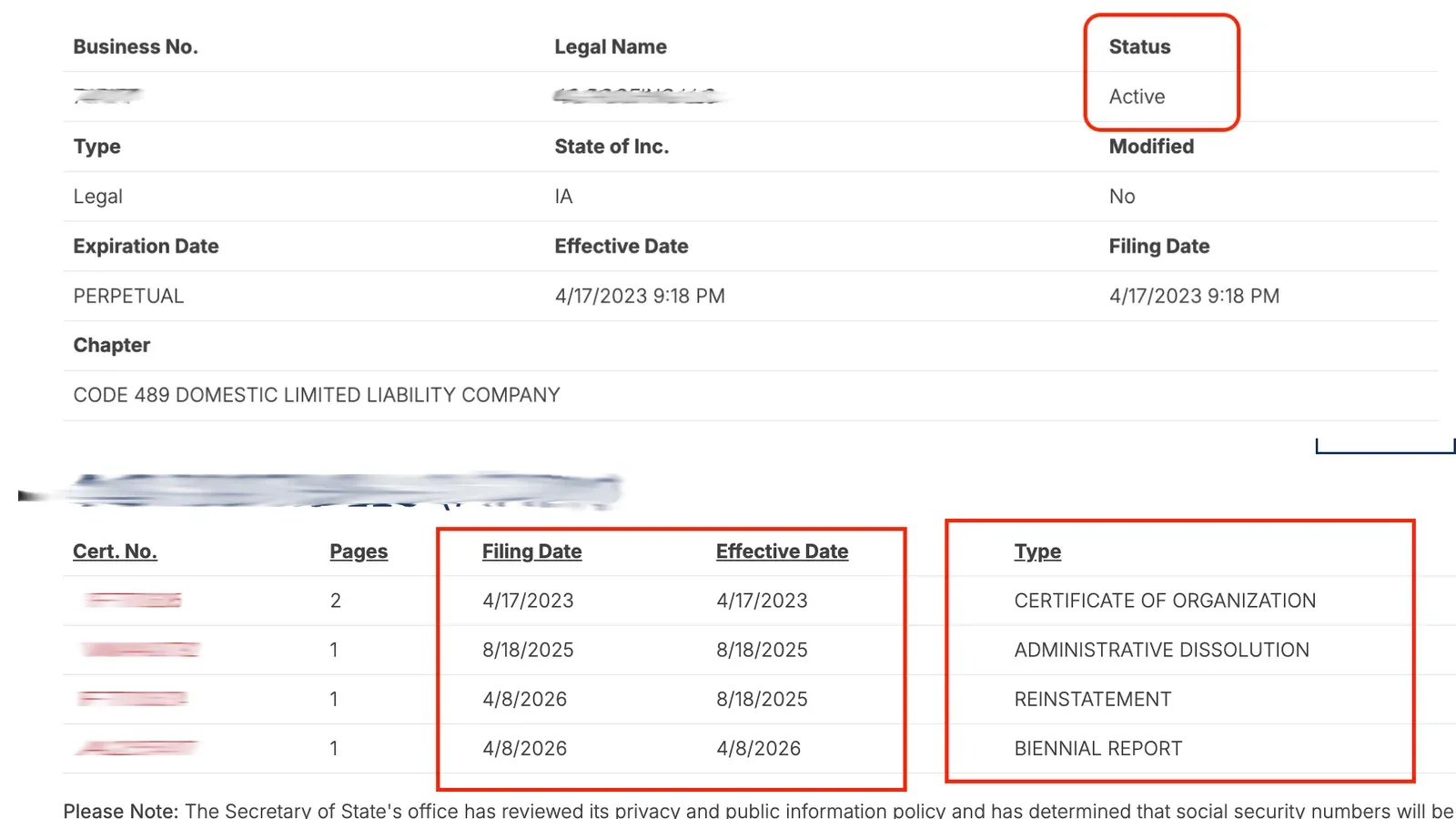
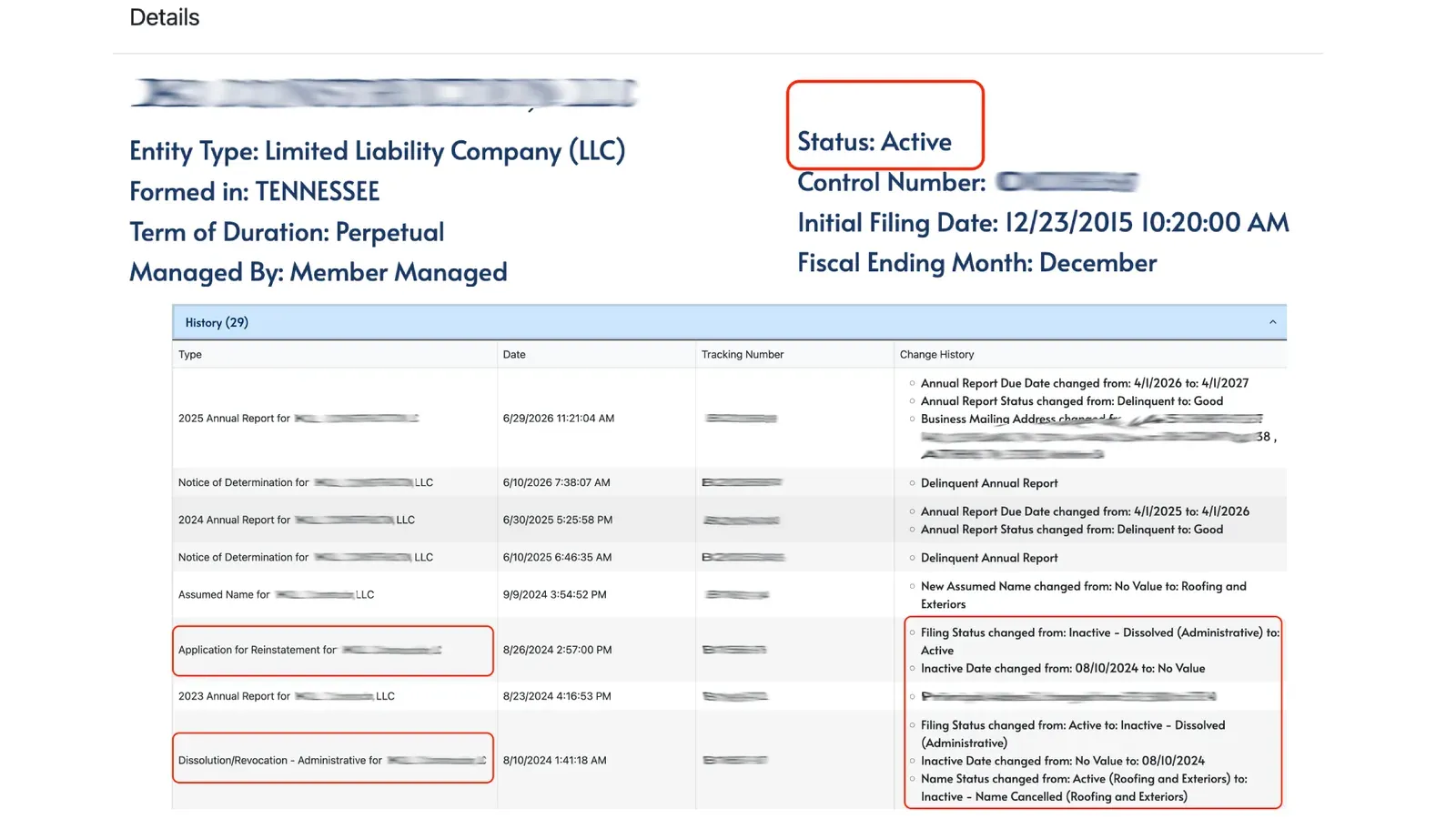
Seven of the 30 companies had at some point been administratively dissolved by the state and later reinstated. All seven showed as “Active” on the day we looked. On none of the three portals did the search results or the record’s summary screen show that history.
The cases we came across:
- In Iowa, a company was dissolved and reinstated about eight months later.
- In Tennessee, a company was reinstated about a year after it was dissolved. The company’s website talks about more than a decade of experience, but its record in the registry is only a few years old.
- Another Tennessee company was dissolved and reinstated on the same day.
- One Tennessee company was dissolved three times and reinstated three times in the last seven years.
- In Kentucky, a company was dissolved for not filing its annual report and reinstated more than a year later.
By state, that is 2 of 10 companies in Iowa, 1 of 10 in Kentucky, and 4 of 10 in Tennessee.
An administrative dissolution can come from an annual report that was not filed on time or a fee that was not paid. On its own, it does not show bad intent. Still, for someone about to do business with that company, it can say two things:
- For a period, the company was not active in the state’s records.
- You cannot tell that from today’s label.
To see the history, you open a different place on each of the three state portals:
| State | Where the history is | What you see |
|---|---|---|
| Iowa | The “Filings” tab on the record page | A dated list of filings, with “Administrative Dissolution” and “Reinstatement” rows |
| Kentucky | The “Show Activities” button on the record page | A dated list of actions; the reason for the dissolution is written as an abbreviation |
| Tennessee | The “History” section in the record window | A dated list of filings, with “Dissolution/Revocation - Administrative” and “Reinstatement” entries |
Company websites often did not give us enough evidence
We searched Google for each company’s legal name and city and looked for the company’s own website. We left out directories, map pages, review sites, and social media pages.
- For 16 companies, the company’s own site did not come up on the first page or could not be found; there were only directory and social media pages.
- For 4 companies, the site did not work or could not be displayed.
- We were able to view only 10 sites.
Six of the 10 sites we viewed carried the company’s full legal name. Two of those six had a small spelling difference: “AND” in the registry, “&” on the site. Three sites gave only the brand name and left out “LLC” or “Inc.” One site gave a legal name completely different from the one in the registry; the company had come up in our search under an old trade name, and today it appears under another name.
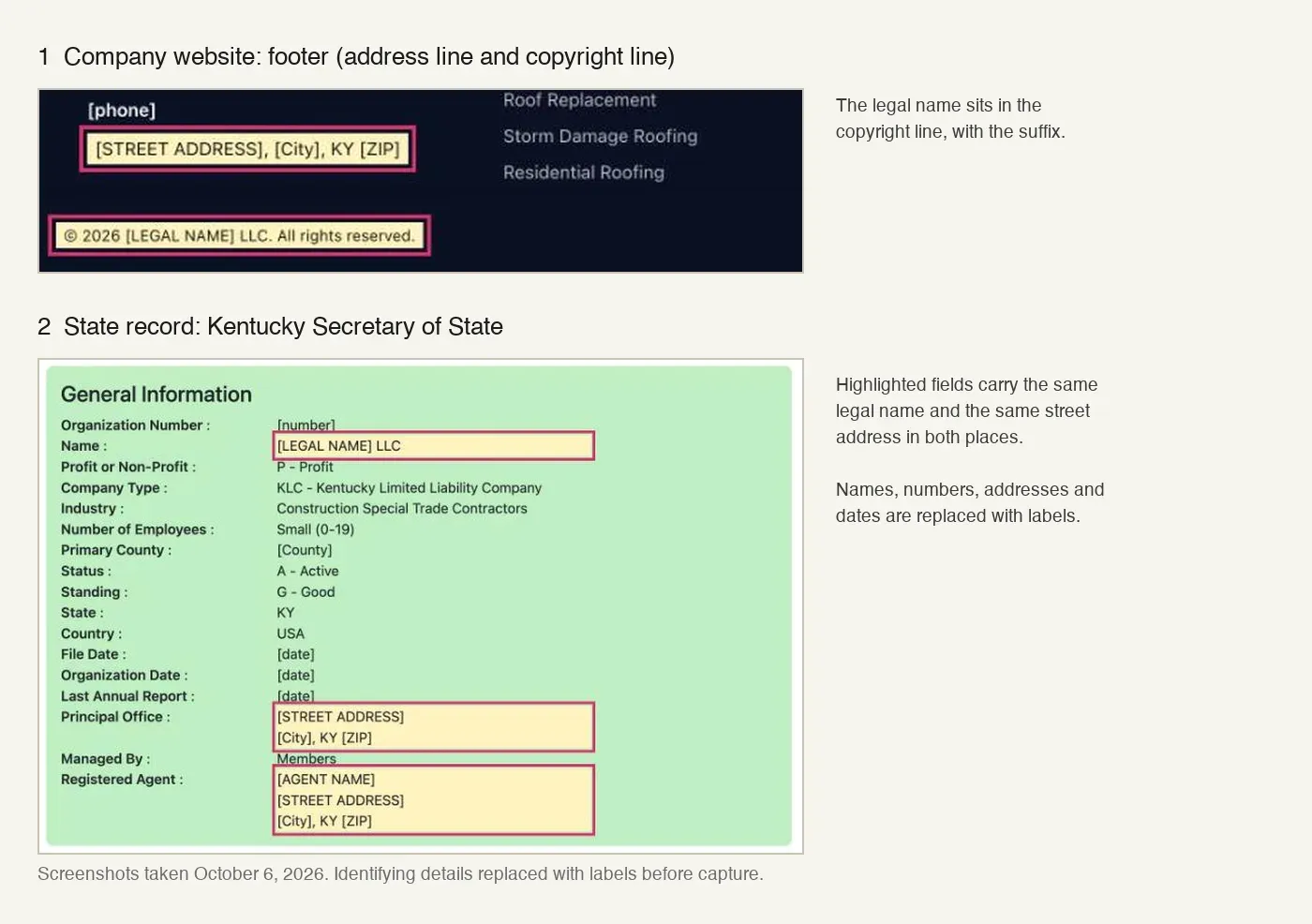
On most of the sites that had the legal name, it was in the copyright line at the very bottom of the page. Most of the sites we read had no terms of use or privacy page.
The best match was the address. On 7 of the 10 sites, the address was the same as the principal office address in the record. On two sites the address was in another state; both were companies with a foreign registration in the state we were looking at.
The gap between the two lines of work was large. We found a candidate site for 11 of the 15 roofing companies and for 3 of the 15 plumbing companies. We did not measure why, and the selection rule was also different in the two rounds.
We saw one more reason not to rely on directory sites. In a few of the checks, map and directory sites showed a different address from the one in the registry, and one directory had copied the registry data word for word.
Seeing who owns the company (whose company is it?)
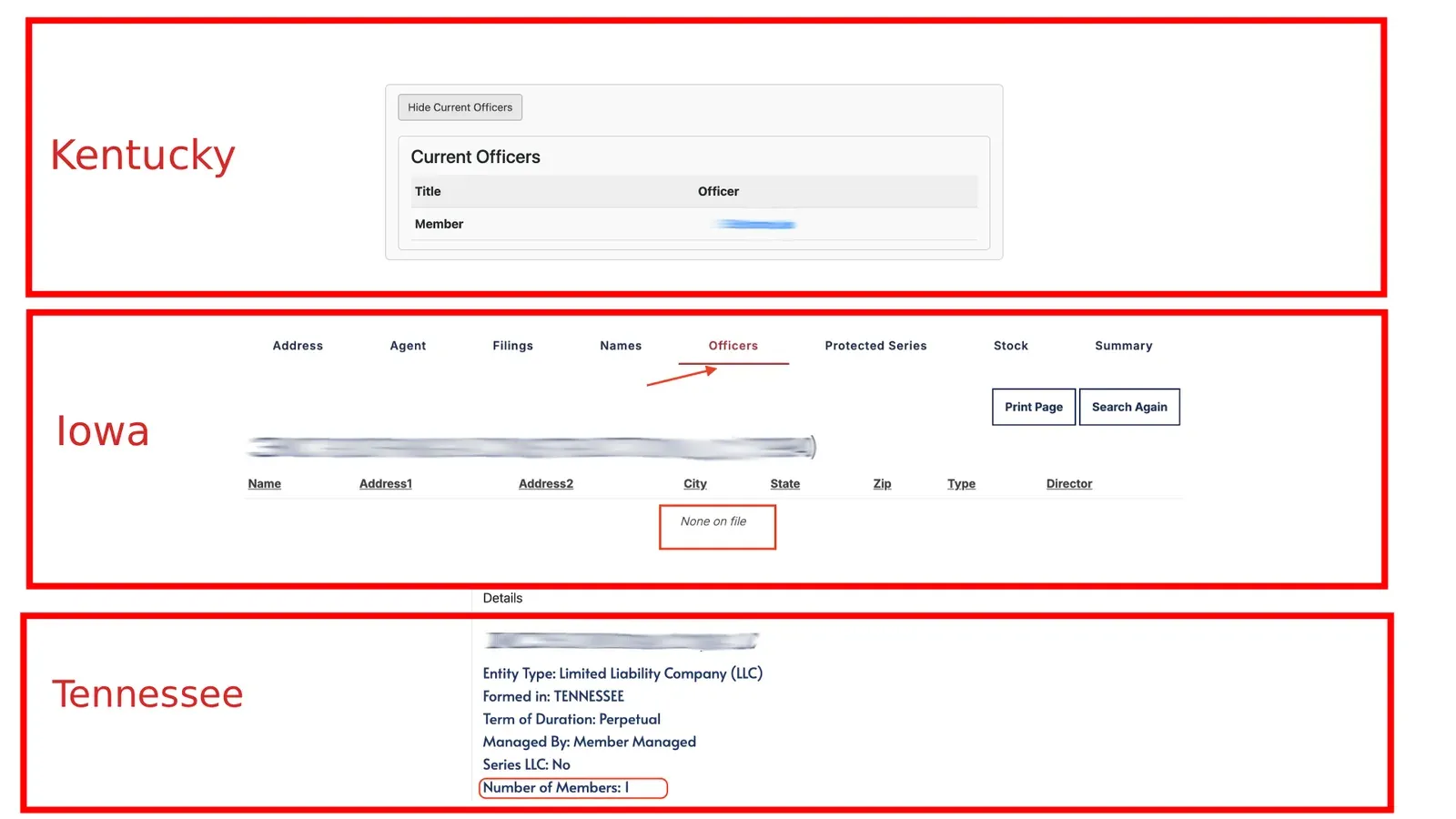
Whether a person’s name (a member, manager, or organizer) appeared in the state’s records depended on the state, not on the company.
| State | Records showing a person’s name | What appears |
|---|---|---|
| Kentucky | 10 of 10 companies | The organizer, or the current managers and members by name; you can also search by a person’s name |
| Iowa | 1 of 10 companies | Officer names on the one corporation; “None on file” on all 9 LLCs |
| Tennessee | 0 of 10 companies | Only the number of members (“Number of Members: 1”); no name |
The registered agent’s name is given clearly in all three states, and we confirmed that on the Secretary of State portals. For 23 of the 30 companies the registered agent was a person; for 7 it was a company: six commercial registered agents and one accounting firm.
A registered agent’s name in the state’s records does not mean that person owns the company. In one of the records, the person listed as the agent and the person shown as the company’s owner on a professional networking site were two different people.
Two companies at the same address, and a trade name registered to a third
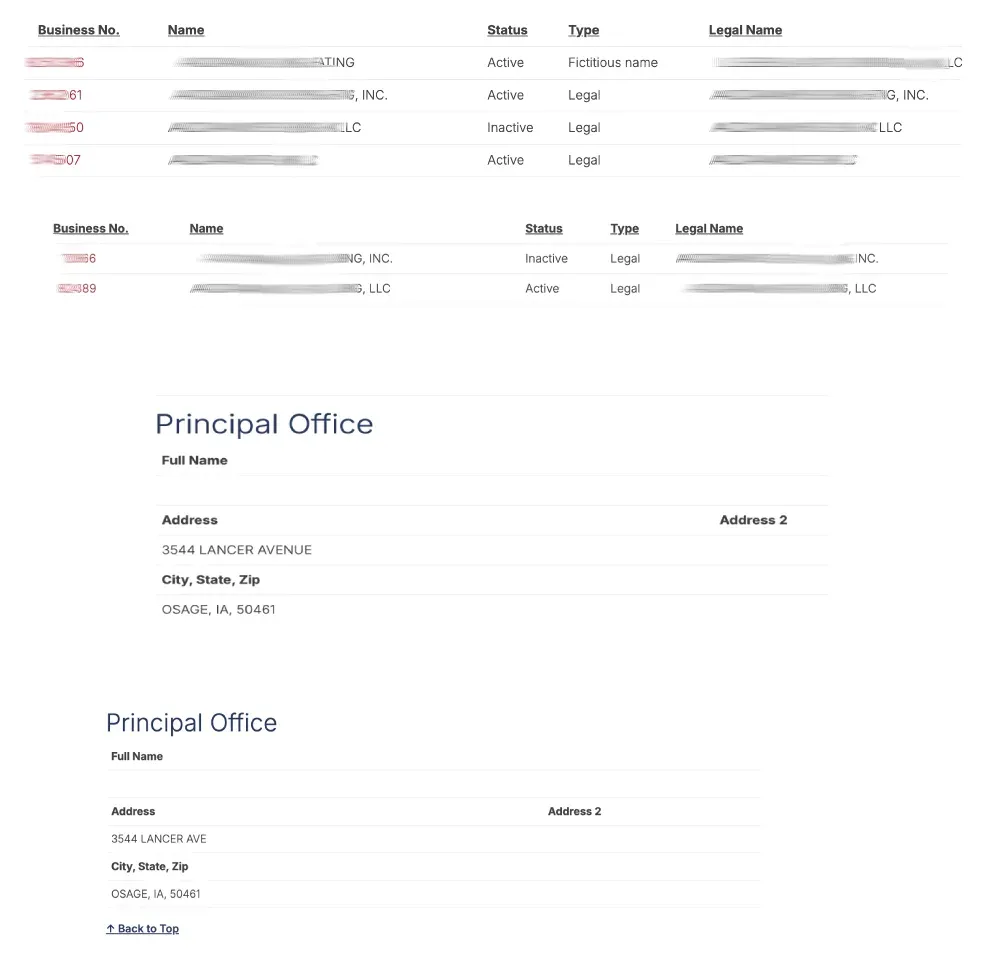
For 7 of the 30 companies, a search on the company’s name brought up at least one more entry in the registry. Some were old, closed records. One company had two old records with exactly the same legal name, and both showed as dissolved.
The most tangled case was this one:
- Two separate active companies are registered at the same address. One is a corporation more than twenty years old; the other is a newly formed LLC.
- Their names are the same words in a different order.
- The LLC has a former name in the registry; it changed its name.
- The same trade name, meanwhile, is registered to a third legal entity.
This is what you might expect to see when a business changes hands, and on its own it proves nothing. But for someone about to pay that business, or to keep trading with it, the question is real: which company is the invoice coming from?
To be honest, we once tried to build our own application to research a company’s background properly and do some real detective work. It was going to be a tool that ran the research from a company name and a state, and it would do all of this automatically.
The biggest trap we fell into during development was that the tool we designed tied a website to an entity record that had already been closed (inactive) and pushed the similar active company at the same address into the background.
The search list can mislead you
Most of the rows in a list can be inactive companies. To reach 30 active companies, we read 107 rows by hand.
- 67 were inactive companies.
- 10 were trade name rows.
- In Kentucky, on the “roofing” search, we went through 38 rows to reach the first five active companies.
Our advice: the first row you see in the list may be an inactive entity record, so pick the row by its status and its number.
The name you search for may not be the legal name.
- In Tennessee, the “roofing” search returned companies whose legal name does not contain that word at all.
- The match was on trade names.
- The company in the first row of the list was a large company that has nothing to do with a roofer.
The search works in three different ways on the three state portals we tested:
| State | How the search behaves |
|---|---|
| Iowa | The note on the page says the search finds names that begin with the letters you type; the search also finds the word in the middle of a name |
| Kentucky | It matches from the start of the name and ignores leading words such as “THE” and “BY.” When we searched for a two-word company whose name begins with “Plumbing” by its second word, the list did not return that company |
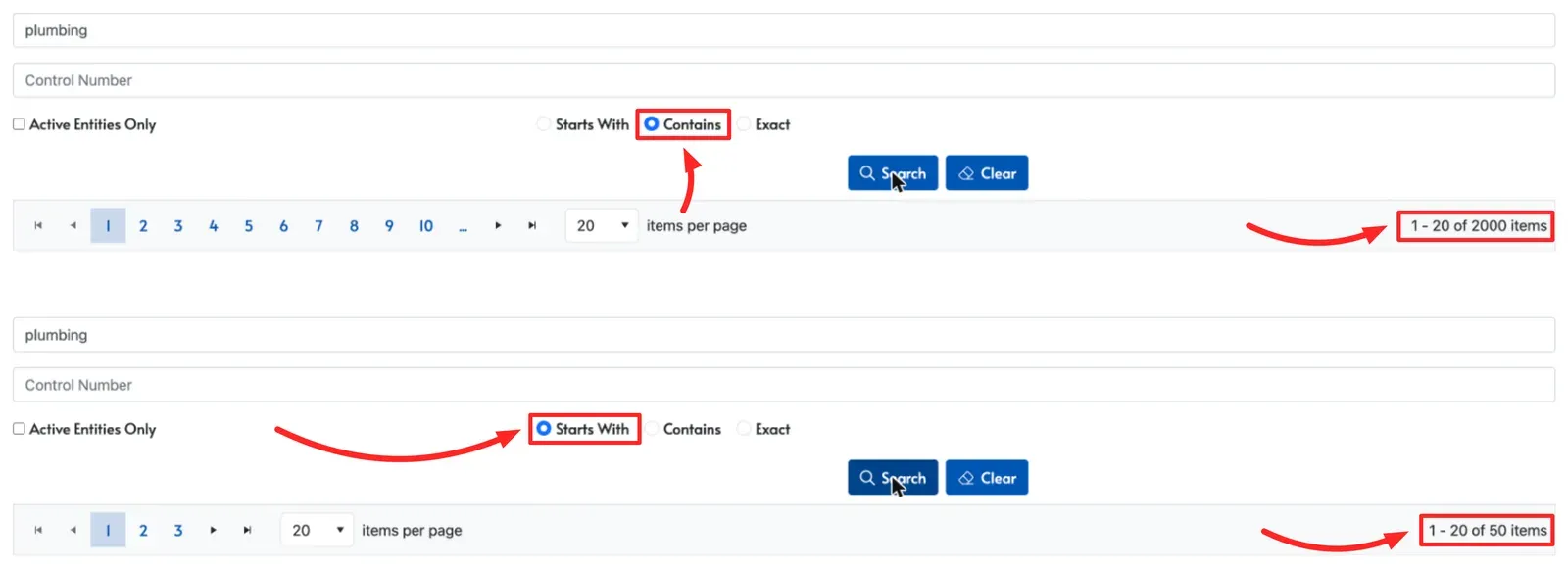
| Tennessee | It has “Starts With,” “Contains,” and “Exact” options. If you go to another page and come back, the selection quietly returns to “Starts With”; the same word gave 50 results on one setting and 2,000 on the other |
So if you have the record number, search by number. All three portals support it, and searching by record number gives a more reliable result than searching by company name. Before you start your research, also ask the other party for this information:
- Company name
- State of formation
- Record number or file number
- Website
- Address
- Phone
The more information you can get from the other party, the better. You get fewer mix-ups and more reliable results.
What follows from these findings, and what to check
| Step | What to do | The finding behind it |
|---|---|---|
| 1 | Ask the other party for the full legal name, the state, and the record number | For 16 of the 30 companies we found no site; the search list can match on a trade name |
| 2 | Open the record by its number | Name search behaves differently from portal to portal |
| 3 | Don’t stop at the summary screen; open the history tab | 7 of the 30 companies showing as “Active” had a dissolution in their history |
| 4 | Run one more search on the core name | For 7 of the 30 companies, another record with a similar name came up |
| 5 | Compare the copyright line at the very bottom of the site, and the address, with the record | That is where the legal name appeared most often; the address matched on 7 of 10 sites |
| 6 | If there is no site, or it does not match, ask for an official certificate | For 16 of the 30 companies we found no site to compare |
On step six: all three states offer a verification page where you can check, by the number printed on it, whether the certificate the company gave you is genuine. Kentucky’s official fee page lists the certificate at $10. Tennessee’s form page says $20 and notes that additional fees may apply. Iowa’s page gives only a $5 fee for a certificate sent by mail; we could not find the online fee.
Questions this check cannot answer
A match between the record and the website shows which legal entity the business in front of you is. It does not show whether the company will deliver the work, whether the person writing to you is authorized to act for that company, or whether an invoice really came from that company. A company record is not proof of a license or of insurance.
Nor can we draw a conclusion about the 16 companies with no site found. It can be perfectly ordinary for a small business to have no website.
How we measured
- Dates: October 5-6, 2026.
- Sources: The official business search pages of Iowa, Kentucky, and Tennessee, and Google.
- Selection: On each portal we searched “roofing” first, then “plumbing.” We took the first five active legal entities in order, starting from the top of the list in the first round and from row 51 in the second. In the second round we skipped rows whose legal name did not contain the search word. The rules were written before we saw the results.
- Collection: The data was collected step by step in a browser, with an AI assistant.
- Website search: Google’s first results page only. A “Page Not Found” result does not mean the site does not exist.
Known limits:
- Thirty companies, three states, two lines of work. Results may differ in other states and lines of work.
- The two rounds used different selection rules, so differences between the rounds may also come from the rule.
- Four candidate websites could not be read.
- The count of similar-name records relies only on a search for the full core name; differences in spelling and word order may have been missed.
All 30 companies, row by row
Company names and registry numbers are removed. Rows 1-15 come from a “roofing” search, rows 16-30 from a “plumbing” search.
| # | State | Industry | Entity type | Registered | Past dissolution | Person named | Website | Legal name on site | Address match |
|---|---|---|---|---|---|---|---|---|---|
| 1 | IA | Roofing | LLC | 2024 | No | No | Not found | — | — |
| 2 | IA | Roofing | LLC | 2024 | No | No | Not found | — | — |
| 3 | IA | Roofing | LLC | 2023 | Yes | No | Unreadable | — | — |
| 4 | IA | Roofing | Foreign LLC (SD) | 2023 | No | No | Read | Full | Other state |
| 5 | IA | Roofing | LLC | 2026 | No | No | Not found | — | — |
| 6 | KY | Roofing | LLC | 2026 | No | Yes | Unreadable | — | — |
| 7 | KY | Roofing | LLC | 2025 | No | Yes | Read | No suffix | No address |
| 8 | KY | Roofing | LLC | 2023 | No | Yes | Read | Full | Same |
| 9 | KY | Roofing | Foreign Inc. (OH) | 1995 / KY 2017 | No | Yes | Read* | Full | Other state |
| 10 | KY | Roofing | Foreign LLC (TX) | KY 2011 | No | Yes | Read | No suffix | Same |
| 11 | TN | Roofing | Foreign Inc. (DE) | 2009 | No | No | Read | Different | Same |
| 12 | TN | Roofing | Inc. | 2005 | No | No | Unreadable | — | — |
| 13 | TN | Roofing | LLC | 2017 | No | No | Read | No suffix | Same |
| 14 | TN | Roofing | LLC | 2020 | No | No | Read | Full | Same |
| 15 | TN | Roofing | LLC | 2015 | Yes | No | Not found | — | — |
| 16 | IA | Plumbing | LLC | 2009 | Yes | No | Not found | — | — |
| 17 | IA | Plumbing | LLC | 2025 | No | No | Not found | — | — |
| 18 | IA | Plumbing | Inc. | 2000 | No | Yes | Unreadable | — | — |
| 19 | IA | Plumbing | LLC | 2016 | No | No | Not found | — | — |
| 20 | IA | Plumbing | LLC | 2014 | No | No | Not found | — | — |
| 21 | KY | Plumbing | LLC | 2026 | No | Yes | Not found | — | — |
| 22 | KY | Plumbing | LLC | 2025 | No | Yes | Not found | — | — |
| 23 | KY | Plumbing | LLC | 2026 | No | Yes | Not found | — | — |
| 24 | KY | Plumbing | Inc. | 2009 | No | Yes | Not found | — | — |
| 25 | KY | Plumbing | Inc. | 2005 | Yes | Yes | Read | Full | Same |
| 26 | TN | Plumbing | LLC | 2008 | No | No | Not found | — | — |
| 27 | TN | Plumbing | LLC | 2019 | No | No | Not found | — | — |
| 28 | TN | Plumbing | LLC | 2022 | Yes | No | Not found | — | — |
| 29 | TN | Plumbing | LLC | 2022 | Yes | No | Read | Full | Same |
| 30 | TN | Plumbing | LLC | 2011 | Yes | No | Not found | — | — |
| Totals | 7 of 30 yes | 11 of 30 yes | 10 read, 4 unreadable, 16 not found | 6 full, 3 no suffix, 1 different | 7 same, 2 other state, 1 no address |
How to read the table:
- Past dissolution: administratively dissolved at some point, now listed as “Active.”
- Person named: an owner, officer, or manager name appears in the registry record.
- Website: searched on Google’s first page only; “not found” does not mean the company has no site.
- Legal name on site: full = legal name with suffix (LLC, Inc.); no suffix = name without it; different = another legal name.
- * Site-to-company match not certain.
Rows were not re-verified a second time. Source: state registry portals and Google, October 5-6, 2026.
This site is not a government agency and does not give legal advice.
Short answers
If the record says “Active,” can I trust the company?
“Active” shows that the company is open in the state’s records today. Seven of the 30 active companies we looked at had been dissolved and reinstated in the past; to see that, you have to open the record’s history tab.
The company has no website. Is that a bad sign?
Not on its own. For 16 of the 30 active companies we picked, the company’s own site did not come up on Google’s first page. If there is no site, ask the other party for the record number and, if needed, an official certificate.
Can I find out who owns the company from the registry?
It depends on the state. In Kentucky, all 10 of the records we looked at had a person’s name; in Tennessee, none of the 10 did.