Business Entity Search: Where to Look Up a Company and What the Record Tells You
There is no national business entity search in the US. Each state keeps its own records. Here is where to search, what a record shows, and what it leaves out.
By Muhammet Dikyurt Published
No search system covers every company in the US from one place. Each state keeps the records of its own companies, and each state has its own search page. To look up a company, you search on that state’s page. The company’s office can be in a different state, so don’t confuse the state where the office is with the state that holds the record.
Searching by business name is free on the official portal of nearly every state. One exception is Texas. SOSDirect, run by the Texas Secretary of State, charges $1 per search, but the Texas Comptroller offers a free name search.
What kind of search are you running?
The table below has seven separate search types. People look for all seven under the name “business search.”
Only one of the seven is a search of company records.
Which search do you need?
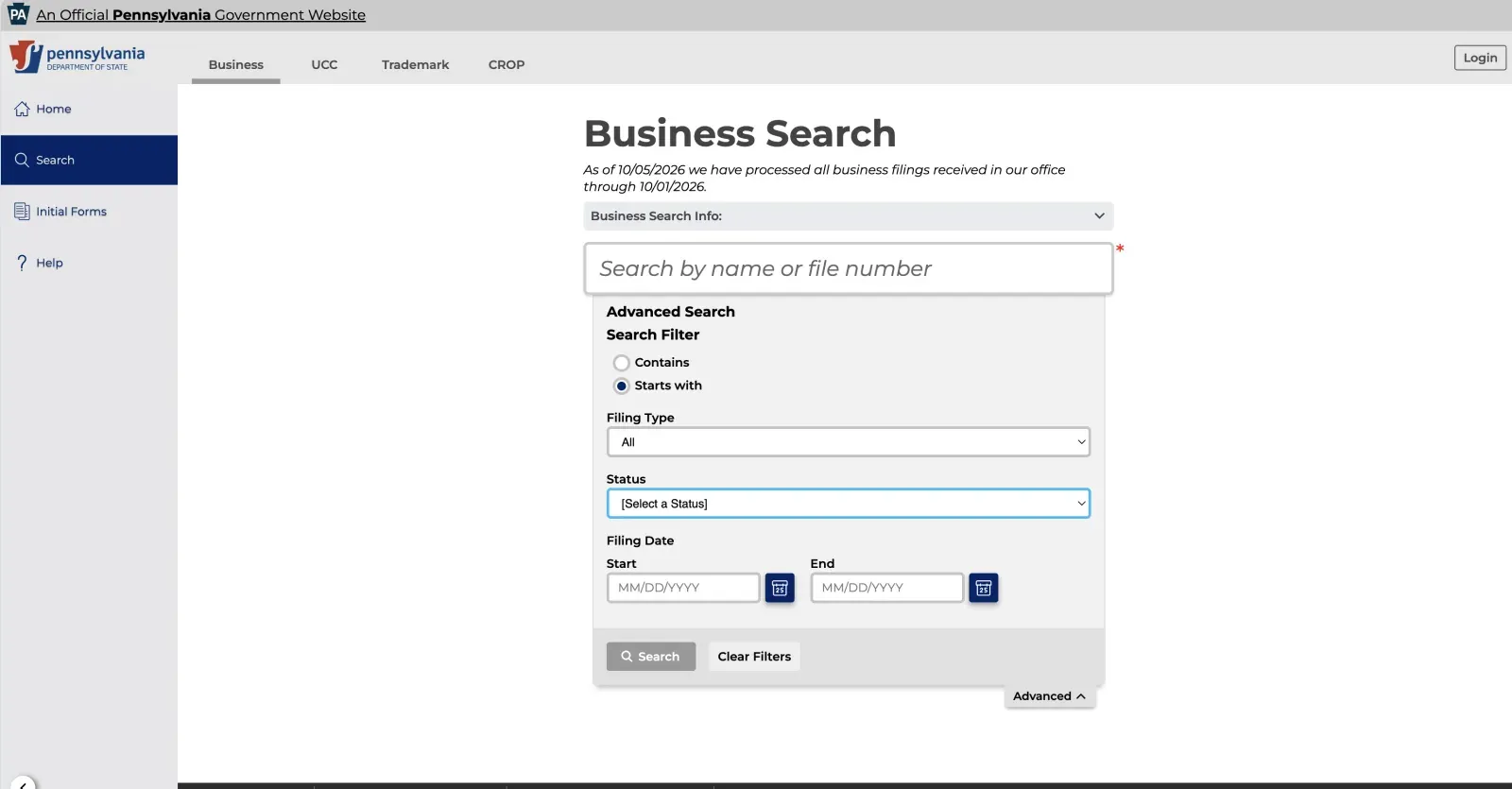
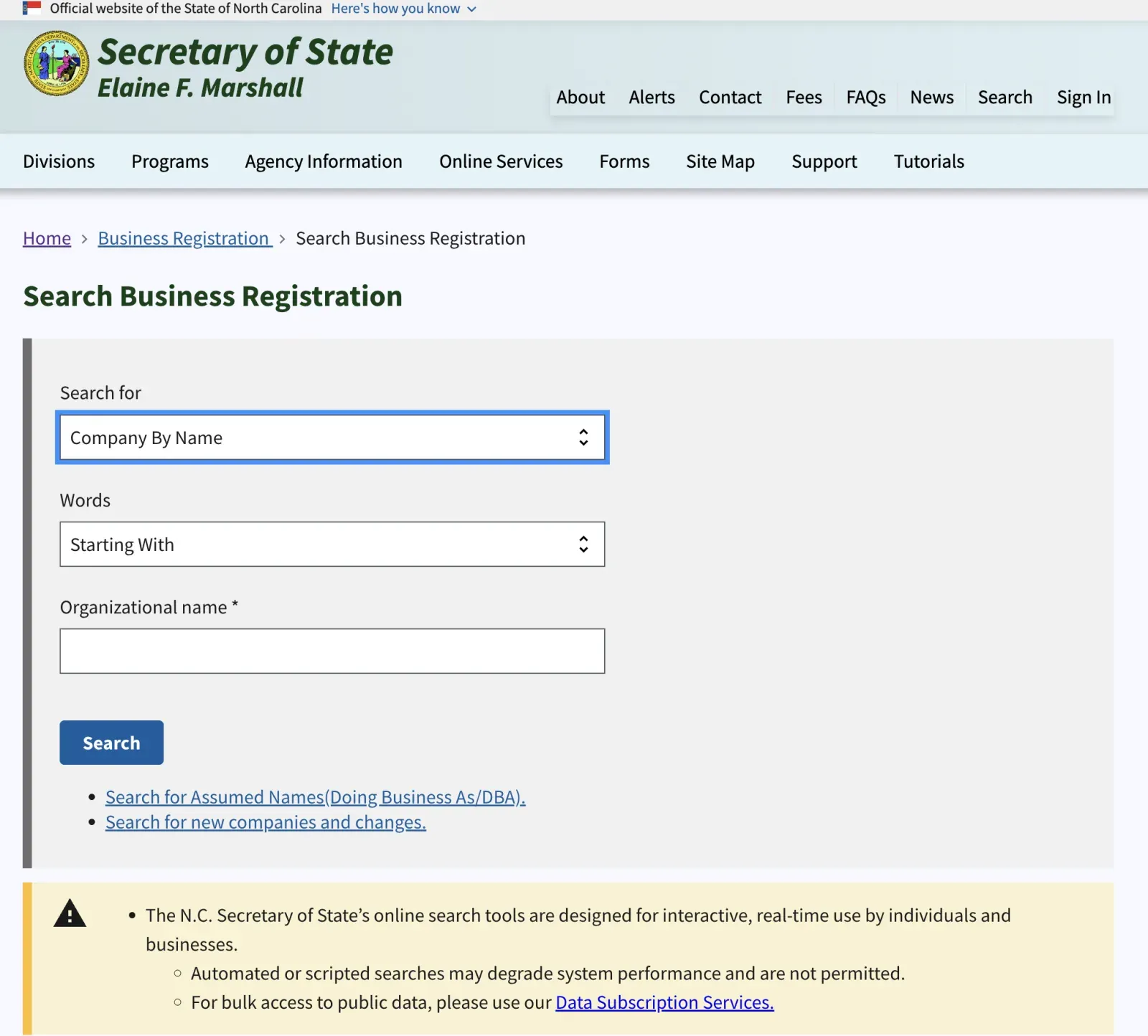
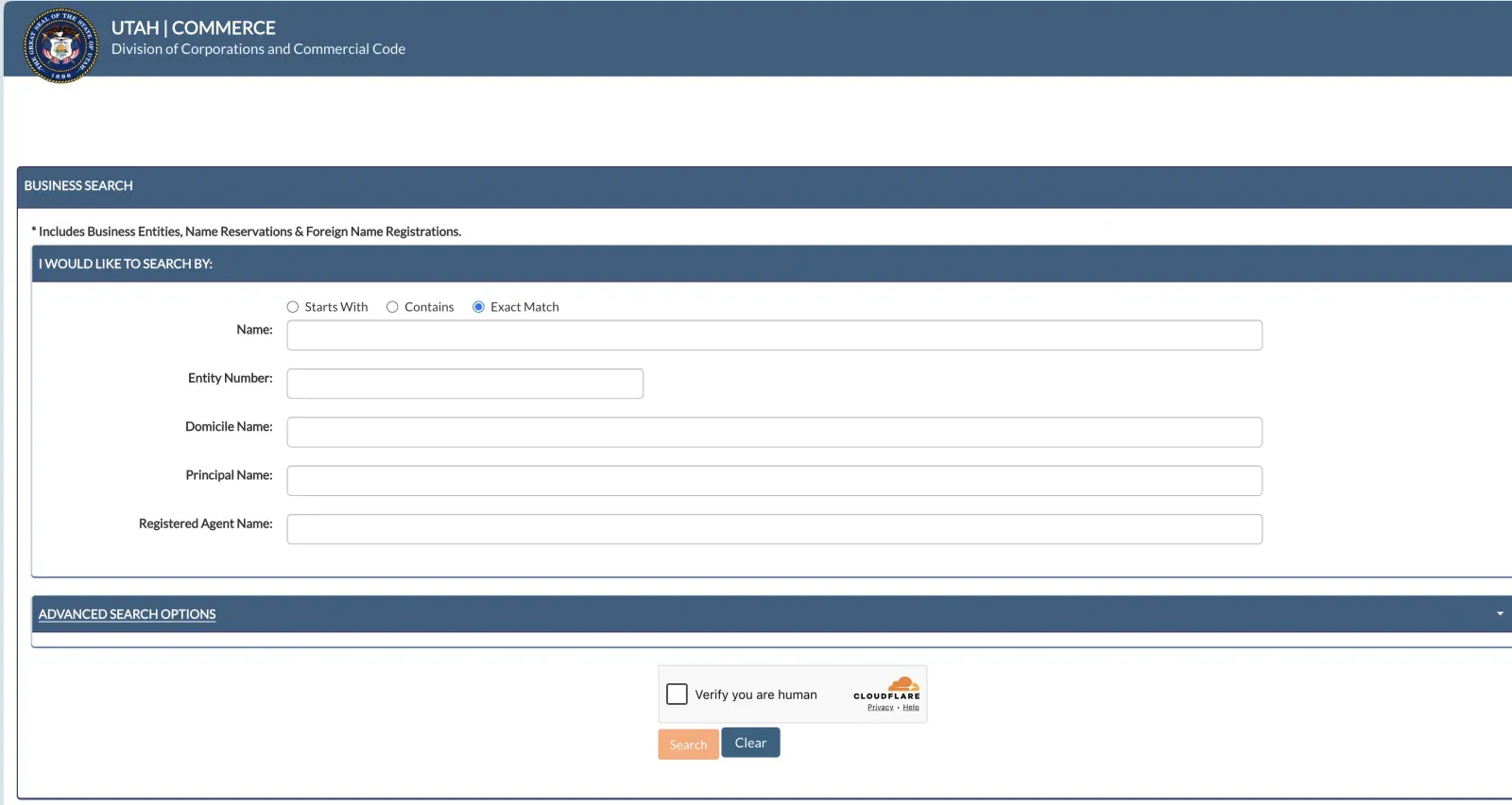
To make this easier to follow, I filled in the table with three example states: Pennsylvania, North Carolina, and Utah.
| What you want to do | Search you need | Where it is done | What won’t do the job |
|---|---|---|---|
| See that a company legally exists | Business entity search | The state’s business registry | — |
| Check whether a name can be registered | Name availability check | In Pennsylvania and Utah, the same tool as the business entity search. North Carolina has two separate tools: the entity search and the assumed business name search. | Trademark search |
| Find the company behind a trade name (DBA) | Assumed name / fictitious name search | In Pennsylvania and Utah, at the state level, inside the business entity search. In North Carolina, the filing is made at the county level (Register of Deeds), and the search is in a separate statewide database run by the Secretary of State. | A business entity search on its own |
| Check whether a trademark is registered | Trademark search | USPTO | Business entity search |
| See the license of a contractor or other licensed professional | License lookup | The state’s licensing board | Business entity search |
| Find the tax ID number (EIN) | — | The IRS issues the EIN * | Business entity search |
| See lawsuits | Court records search | Federal and state courts | Business entity search |
* The IRS issues the EIN, not the state. Most state portals do not show it. The number you see is usually the entity number or file number the state itself assigned. A few states, such as Florida, show the EIN in the record, but that is the exception.
Details for the example states (Pennsylvania, North Carolina, Utah)
This table covers only three example states. A general list with more states will be shared later.
| Pennsylvania | North Carolina | Utah | |
|---|---|---|---|
| Agency that keeps the registry | Department of State, Bureau of Corporations and Charitable Organizations | Secretary of State, Business Registration | Division of Corporations and Commercial Code |
| Local name for a DBA | fictitious name | assumed business name | DBA |
| Where a DBA is filed | State (Department of State); no county filing | County (Register of Deeds); a single filing can cover all 100 counties | State (Division of Corporations) |
| Does the DBA show up in the entity search? | Yes, in the same search | No, separate database | Yes, in the same search |
| Does a DBA block a new company name? | Not stated in the record (the text of § 202 lists company names and reserved names) | No, the distinguishability test looks only at entity records | Yes, registered DBAs are part of the test |
| DBA fee and term | $70, no expiration | $26, no expiration | $22, 3 years |
| Last verified (DBA record) | August 10, 2026 | July 21, 2026 | October 1, 2026 |
Not every result in a state portal search is a company. In a test search of Arizona’s records, I saw “Name Reservation” rows among the results. A name reservation means someone has set the name aside for future use. There may not be a formed company behind it yet. You need to keep the two apart.
Business entity search links for the three states
- Pennsylvania: file.dos.pa.gov/search/business (entities and fictitious names together)
- North Carolina entity search: sosnc.gov, Business Registration search
- North Carolina assumed business name search: sosnc.gov, assumed name search
- Utah: businessregistration.utah.gov, entity search (entities and DBAs together)
The portals I tested
| State | Official portal | Free? | Account required? | Search by officer name? | Documents | Test date |
|---|---|---|---|---|---|---|
| Pennsylvania | Business Search, Department of State | Name search is free | No | No | Account required | October 5, 2026 |
| North Carolina | Business Registration Search, Secretary of State | Name search is free | No | Yes | Free, open to the public | October 5, 2026 |
| Utah | Business Search, Division of Corporations and Commercial Code | Name search is free | No | Yes | Free, open to the public | October 5, 2026 |
Which state holds the record?
Someone looking up a company that has a physical shop or location in Texas may not find it on the Texas portal and decide the company is not registered.
But the search looks only at that state’s files. The company may have been formed in Delaware or another state, and its main record is there.
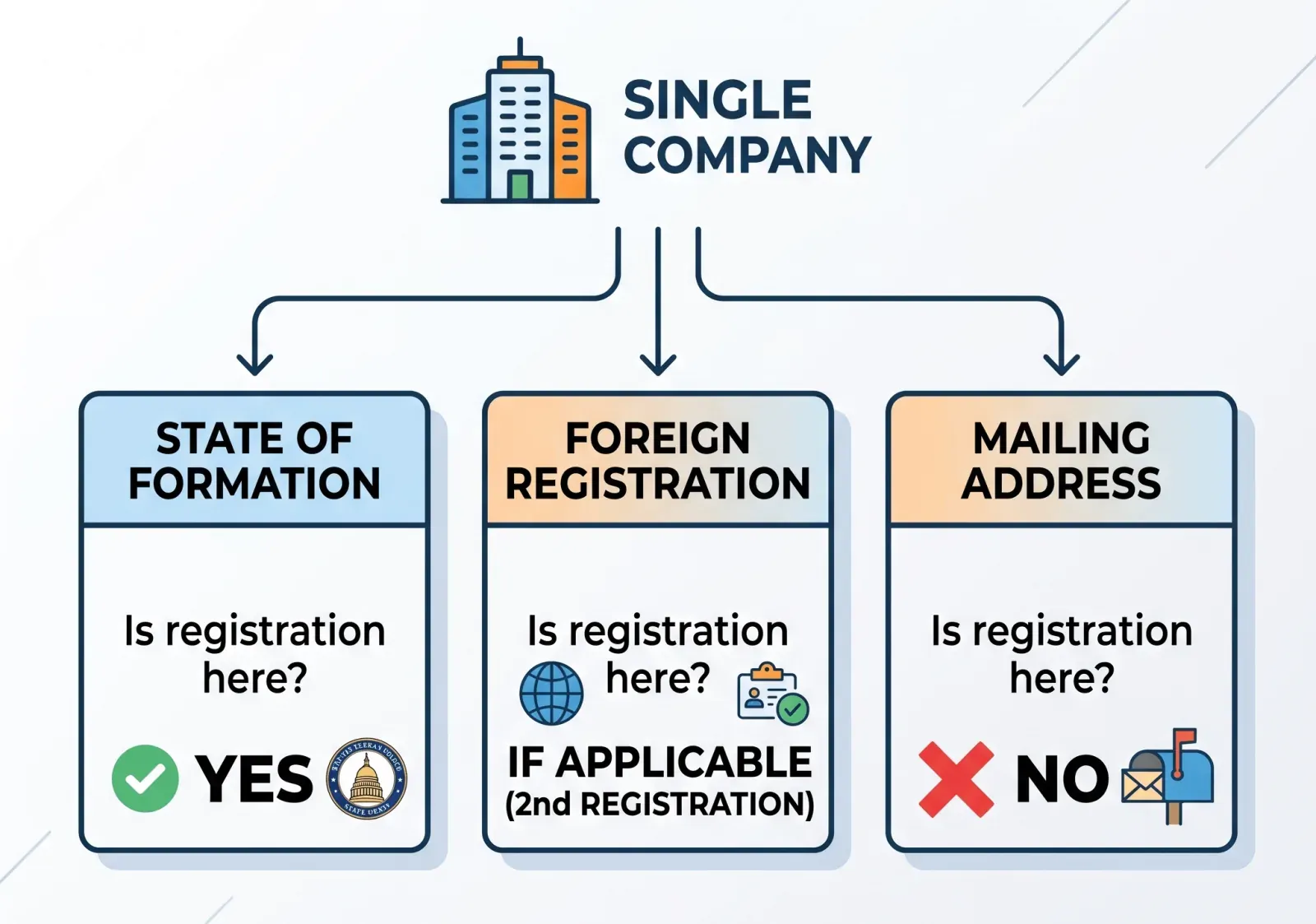
A company’s name can show up in three different places, tied to three different states:
- State of formation. The state where the company was formed and where its main record is kept.
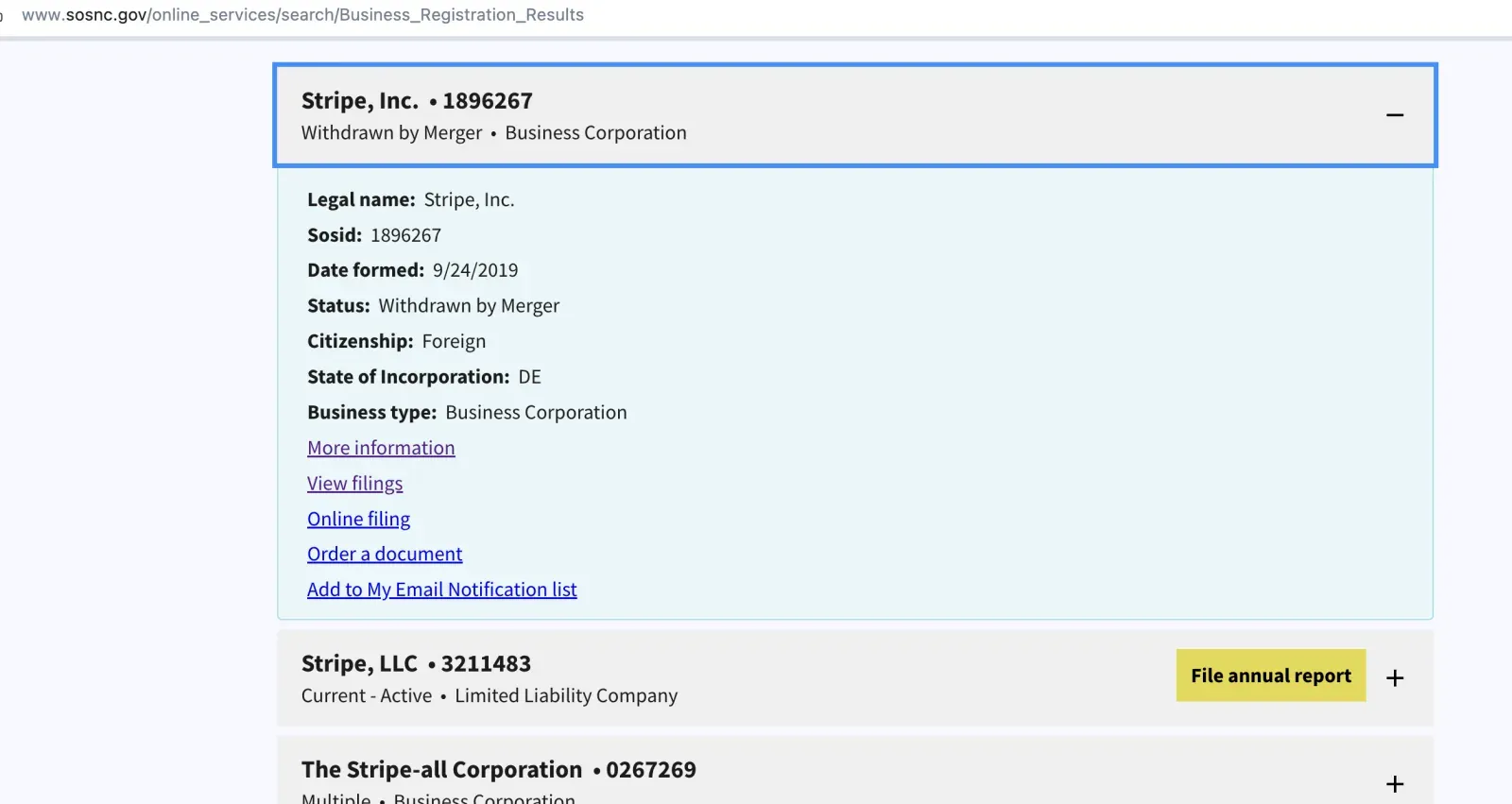
- Foreign registration. If the company also does business or has operations in other states, it may be registered separately there. In that case there can be more than one record, and they do not all show the same information. One of the records I tested belonged to a company formed in Delaware and registered in Tennessee. The registry showed the two in separate fields.
- Mailing address. The address on the website or the invoice. The record may not be in this state.
An example:
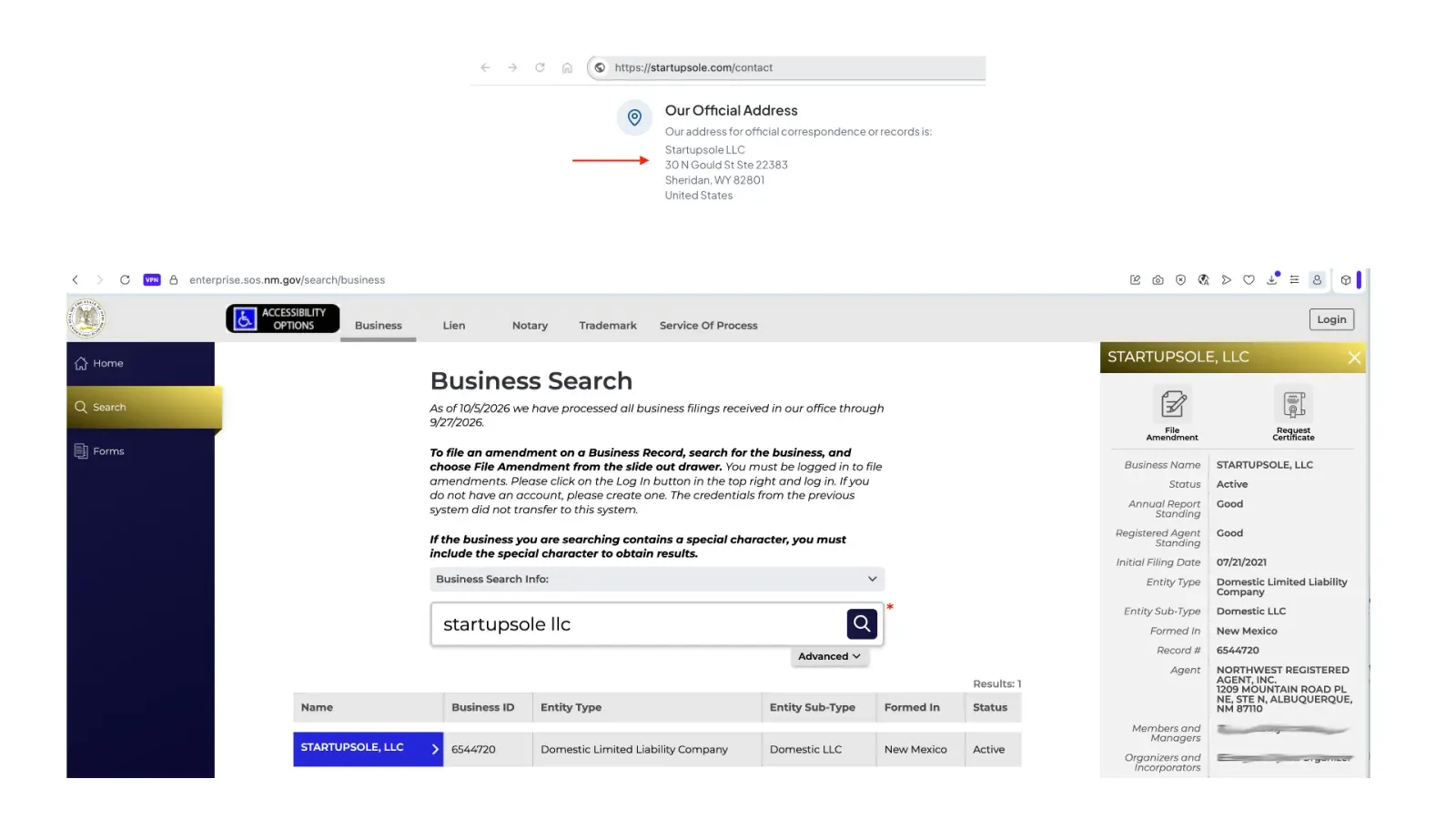
The closest example I can point to is Startupsole LLC.
The contact address on its website is in Sheridan, Wyoming. The company’s record is in New Mexico. The Wyoming address is a mailing address. Someone who searches the Wyoming portal will not find the company and will reach the wrong conclusion.
If you don’t know the state, look at the document you have. An invoice, a contract, or the legal pages of the website may give the legal company name together with its state (for example, “a Delaware limited liability company”).
What does the record show you?
A company record is like an ID document. It tells you who the company is. It does not tell you what the company is like.
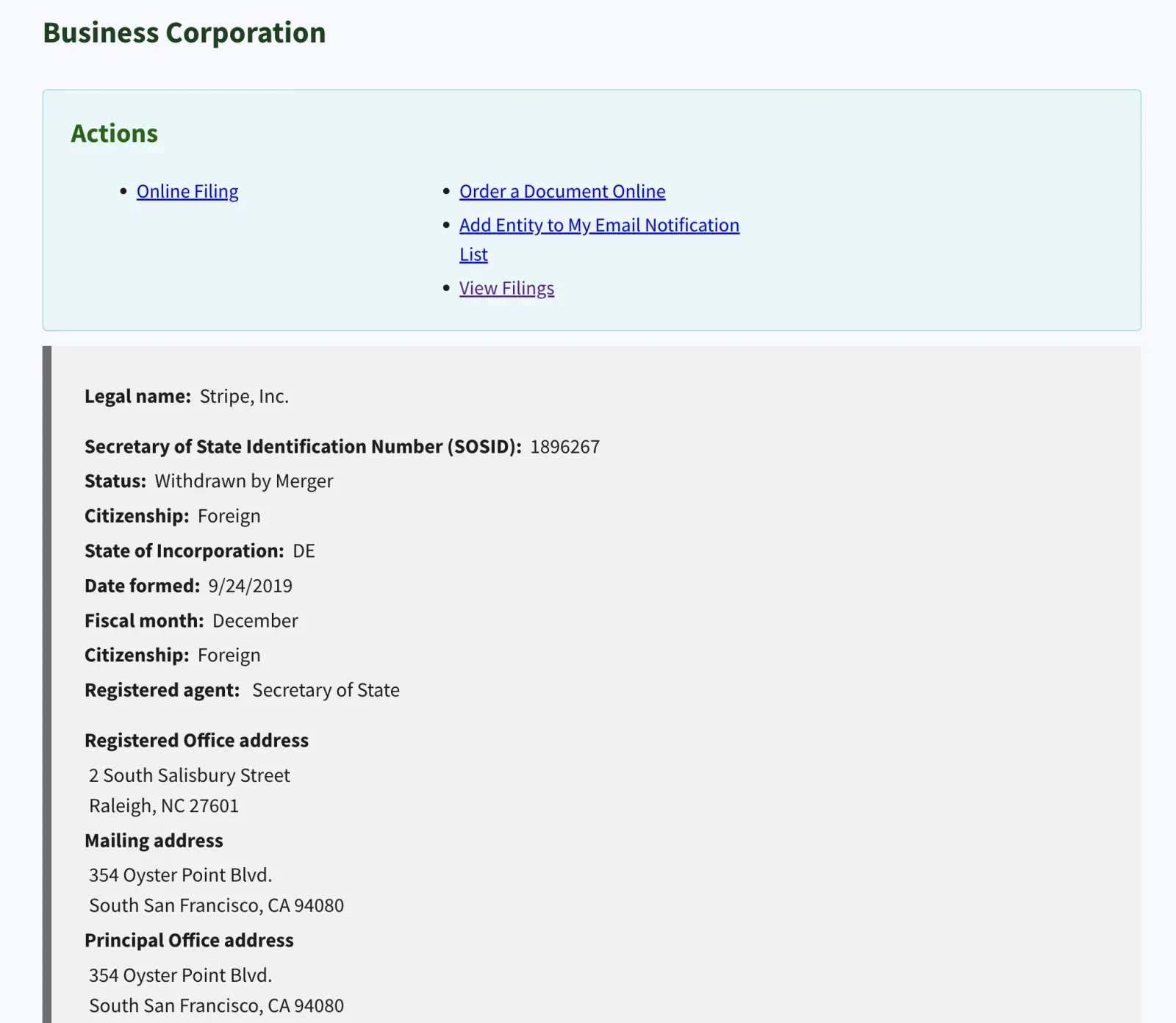
Most states give you this information:
- the legal name
- the entity type
- the record number assigned by the state
- the status in the state’s records
- the formation date and the registered agent address where official notices are sent
Which details appear varies by state.
| Field | What it tells you | What it does not prove |
|---|---|---|
| Legal name | The full name as registered | That the brand you know belongs to this company |
| Record number | The company’s ID number in that state | It is not the EIN. That the company carries the same number in other states |
| Entity type | LLC, corporation, and so on | Size, ownership, or how it is taxed |
| Status | Where the company stood with the state on that date | That it is operating or has paid its debts |
| Formation date | The date of the registration in this state | The age of the business |
| Registered agent | The person and address where official notices are sent | The company’s owner or manager |
| Principal address / mailing address | An address on file | Where the company really operates |
For a field-by-field reading of 30 records in three states, see How to Read a Business Entity Search Result.
What information is not in the record, and where do you get it?
A company’s owner may not appear in every state’s record, though in some cases it does. If the information was reported to the state and that state does not guarantee anonymity, it can appear on the portal.
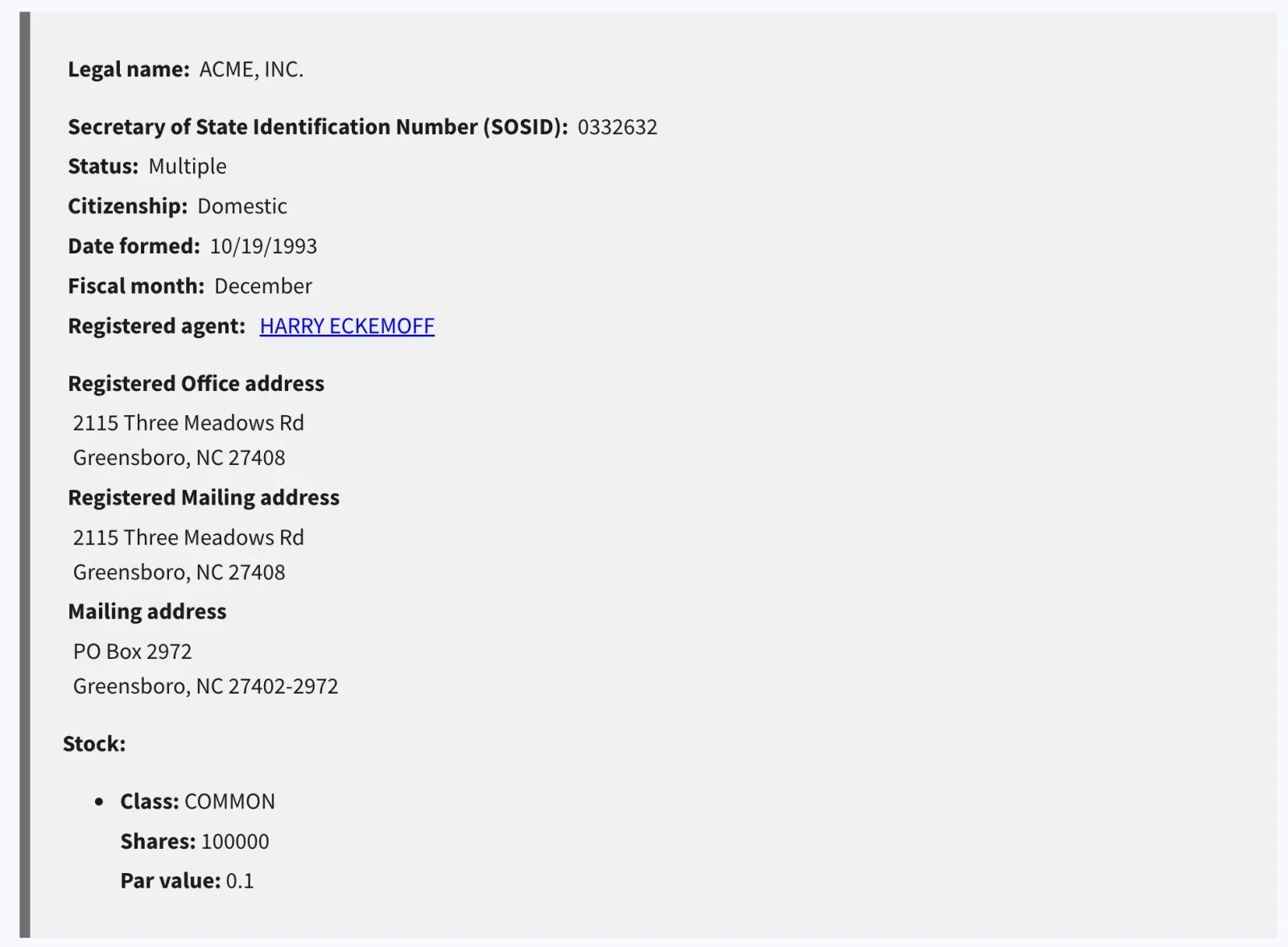
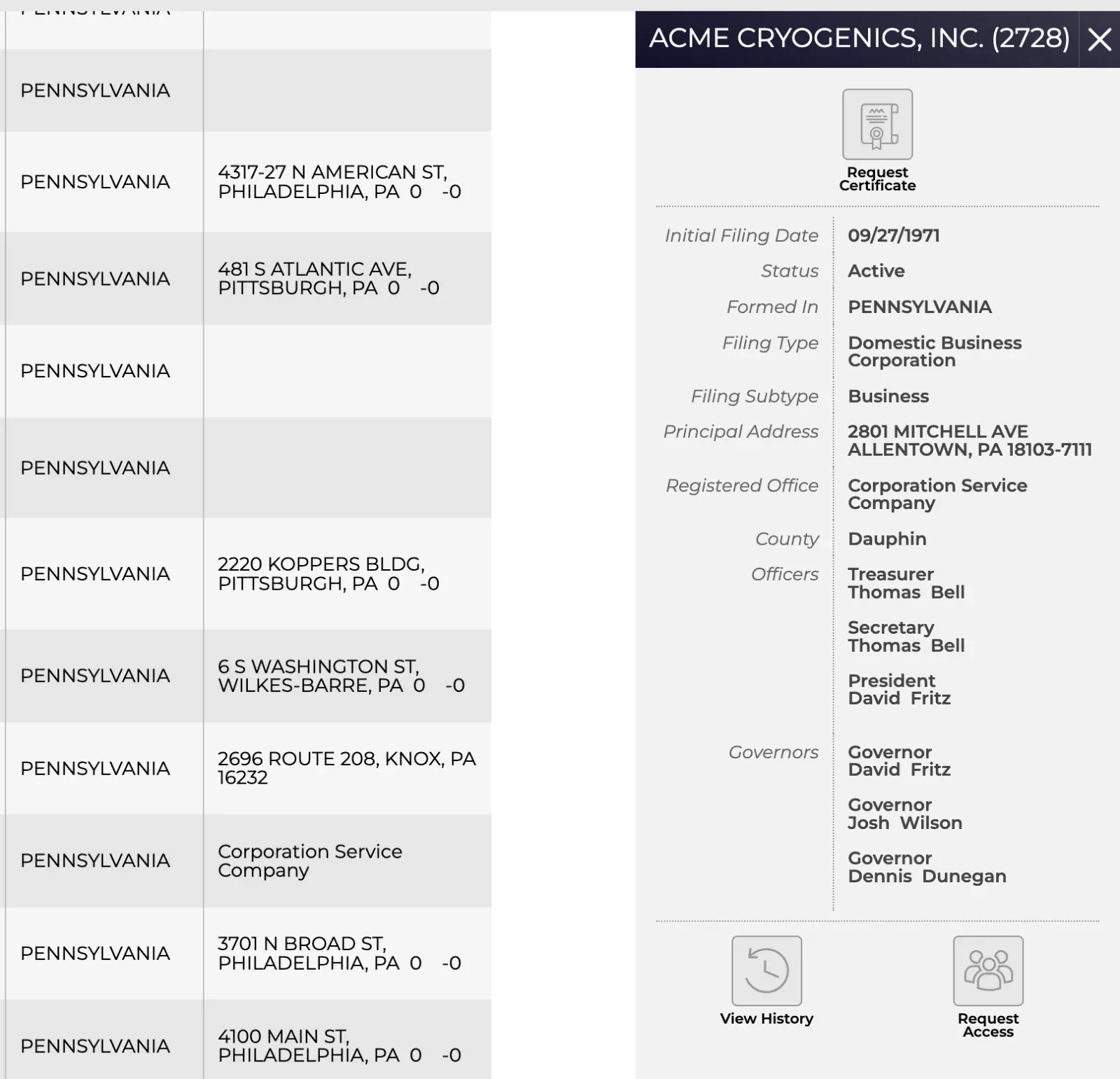
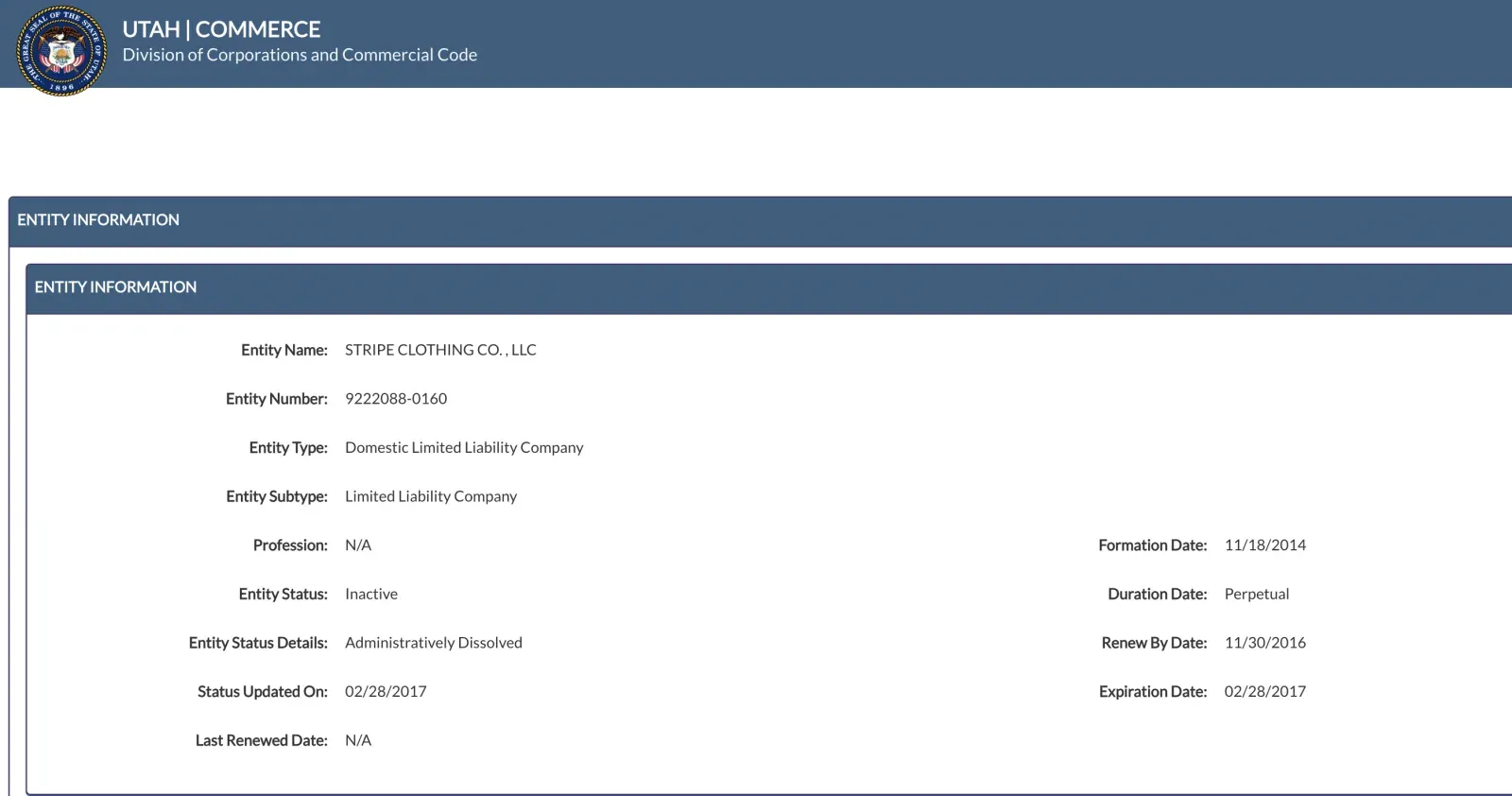
When you see a person’s name in a record, check the title it is listed under. Someone listed as a manager, officer, or organizer may not be the real owner of the company.
There is no open ownership search at the federal level either. The beneficial ownership information (BOI) that FinCEN collects is not public. According to FinCEN’s own page, companies formed in the US are now exempt from this reporting as well; only companies formed in a foreign country and registered in a US state file a report.
Source: fincen.gov/boi (read on October 5, 2026)
| What you are looking for | In the state record? | Where to look | Watch for |
|---|---|---|---|
| Owners / members | Varies by state | Annual reports, formation documents | A manager is not necessarily an owner |
| EIN | No in most states. It can be found only in IRS records | The company itself, a Form W-9, the IRS (not public) | The number in the record is the one the state assigned, not the EIN |
| Revenue, financial condition | No | No public source for private companies; SEC EDGAR for public companies | — |
| Lawsuits | No | Court records | A lawsuit being filed does not mean the claim was proven |
| Licenses | No in most states | State licensing boards; city and county license records | An active company record does not show that the company is licensed |
| Government-backed loans | No | SBA’s open loan data | It does not include a state record number |
| Trademarks | No | USPTO for federal trademarks; the state’s own trademark registry for state trademarks | A trademark does not show that there is a separate subsidiary |
Tying these sources back to the company record is harder than it looks. SBA’s loan data has no state record number, so matching depends on the company name and the state.
When I tried this on four real companies in 2026, I did not get a reliable match. In one of them, the name, city, and ZIP code matched but the street number was different, so I could not identify that record as the same company.
The company name was not enough in court records either. In a federal case I reviewed in September 2026, there were two defendant companies at the same address. One was formed in California, the other in Delaware. I could tell which one was the record I was looking for only when the name, the state of formation, and the address all matched together.
The critical case: same name, different company
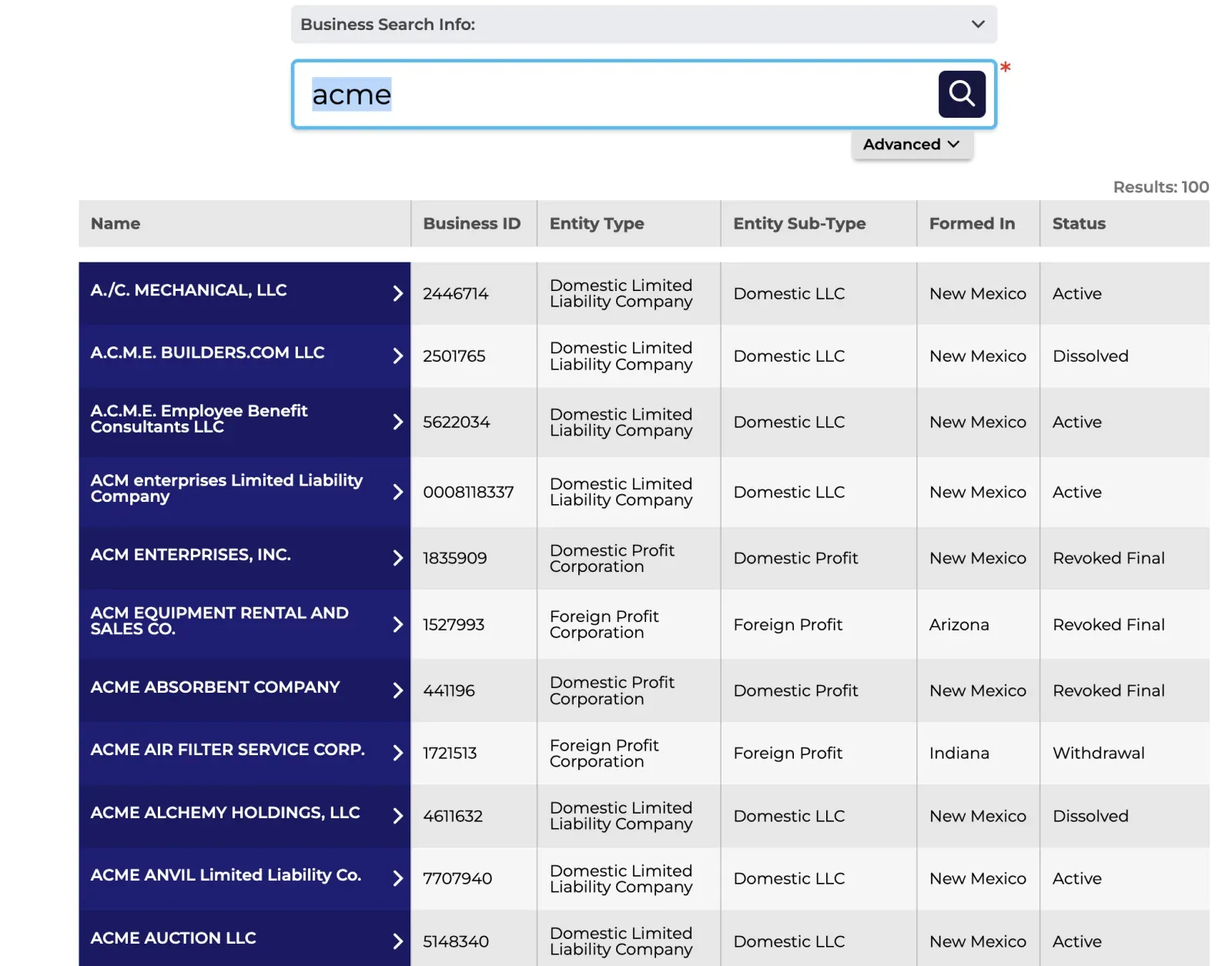
When you run a search on a state portal, you may see more than one row of results with the same name.
The easiest thing to do then is pick the top record. But a name is not a company’s identity. The identity is the state combined with the record number that state assigned.
A name is unique only within a single state’s records. In another state, a different company can carry the same name. You may even see companies with the same name in every state.
Four cases I ran into in testing
One name, many records. A search on the name of a restaurant chain returned many different records carrying that name: a real estate company, a holding company, a company with “Enterprises” added, and an old “Inc.” record that is no longer in use.
An active record with a similar name next to a closed one. According to the record of a construction company in Connecticut, the company had closed in March 2026. I found a second company at the same address, using the same website, with “Group, LLC” at the end of its name. On the first page of the free registry search, this second company showed as “Active.” Someone who looked only at the first record would think the company had closed. Someone who looked at the second would think nothing was wrong.
Same name, two different states. While looking for a construction company with a 2005 record in Colorado, a website under the same name caught my attention. The site belonged to a different contractor, one that said it was founded in Indiana in 1983.
LLC and Inc. versions of the same company name. In Arizona I found an LLC record and an Inc. record with the same name. The two were separate legal entities. In the records, one showed as active and the other as inactive. How often you will see this depends on the state. In some states, such as Colorado, a different suffix is enough to distinguish a name from the others, and the two versions can be registered at the same time. In states such as Arizona and Indiana, the suffix does not count, and the two versions usually appear side by side only after one of them has closed.
To pick the right row, compare these five details against the document you have:
- Full legal name, including the suffix (“LLC”, “Inc.”) and added words such as “Group”, “Enterprises”, or “Holdings”.
- State.
- Record number, if you have one.
- Formation date.
- Address.
When you compare addresses, don’t let spelling differences throw you off. “DR.” and “Drive”, or “STE.” and “Suite”, refer to the same address. A matching address may also not be enough on its own in some cases: a registered agent address is a shared address used by thousands of companies.
Status words change from state to state
“Active” in a record says the company was open in the state’s records on that date. It does not prove that the company is operating, has paid its debts, or can be trusted.
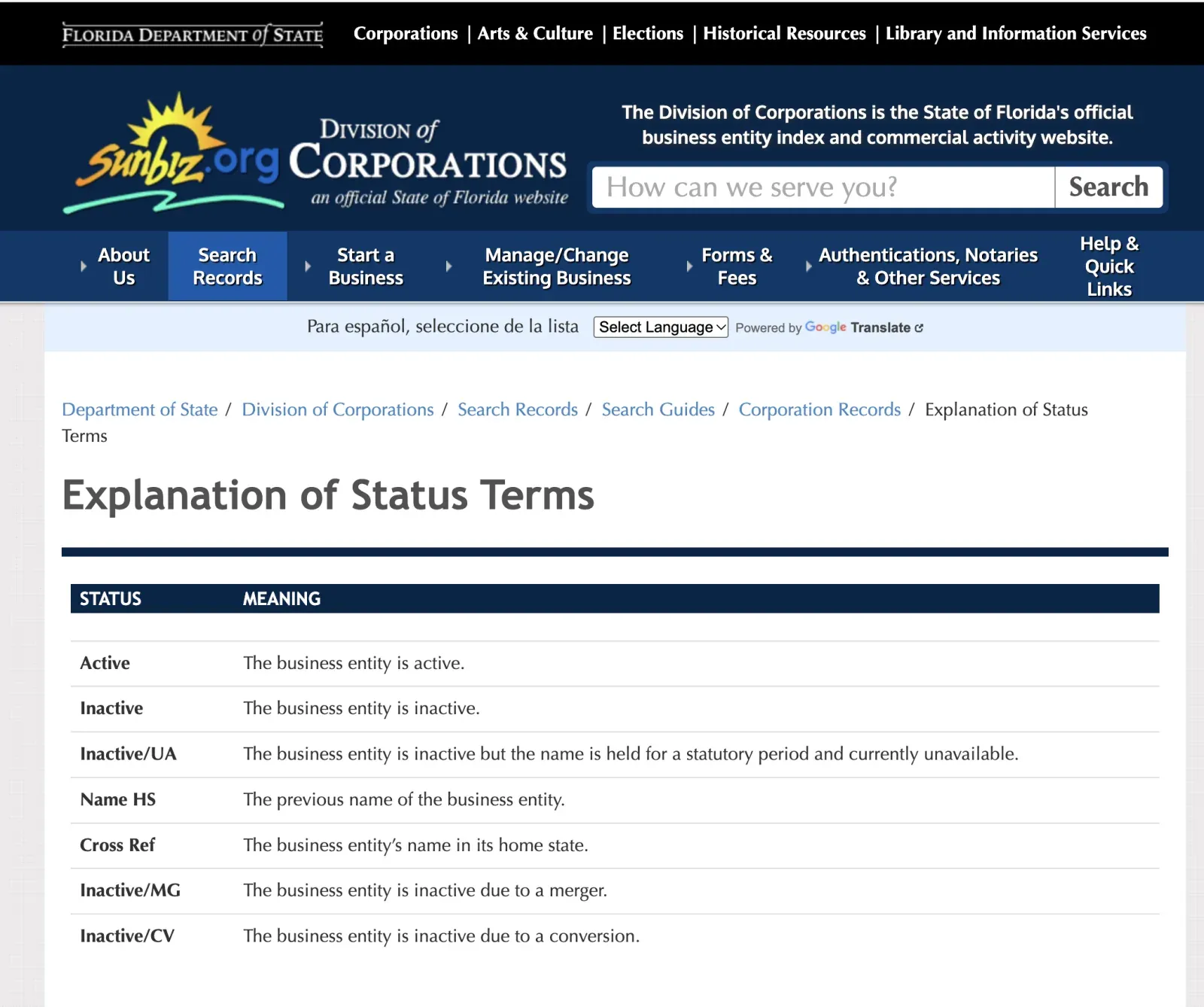
Each state defines its own status words. The table below gives the general meanings. If a state’s own definition is different, that state’s term applies.
| Status word | General meaning | What to do |
|---|---|---|
| Active / In existence | Registered and not closed | Check the date of the record |
| Good standing | Filings and fees are current | — |
| Delinquent / Past due | A filing or fee is late; the company still exists | Ask the company |
| Suspended / Forfeited | Rights are suspended or lost because an obligation was not met | Treat it as a warning |
| Dissolved / Cancelled / Expired | Closed, either at the company’s request or by state decision | Look at the date and at whether there is a successor company |
| Withdrawn / Revoked | The foreign registration in that state has ended, either at the company’s request or by state decision | Look at the record in the state of formation |
| Merged | Merged with another company | Find the surviving company |
What I have seen with status data
The word in the official record and the word on a third-party site or search tool may not be the same.
In one project, I tried to produce automated company reports from these records. The statuses Delinquent, Suspended, Merged, and Withdrawn all came down to the single word “Inactive.” A late annual report and a closed company carried the same label.
Third-party data can also be wrong. A data provider I tested showed a large company in Florida as inactive in two separate queries. On the state’s official page, the same company’s status read ACTIVE.
A status also has a date. One data provider whose documentation I looked through refreshed its status data at intervals of one to six months, depending on the state. So the data was stale, not live. The date it showed was the date the data was last seen, not the date the status changed.
The record you see on the official portal gives the most accurate result because the data is fresh.
“No results” does not mean “no company”
Some searches on a state portal come back with an empty results screen.
An empty results screen can come from one of the seven causes below, and only the last one shows that the company is not registered in that state.
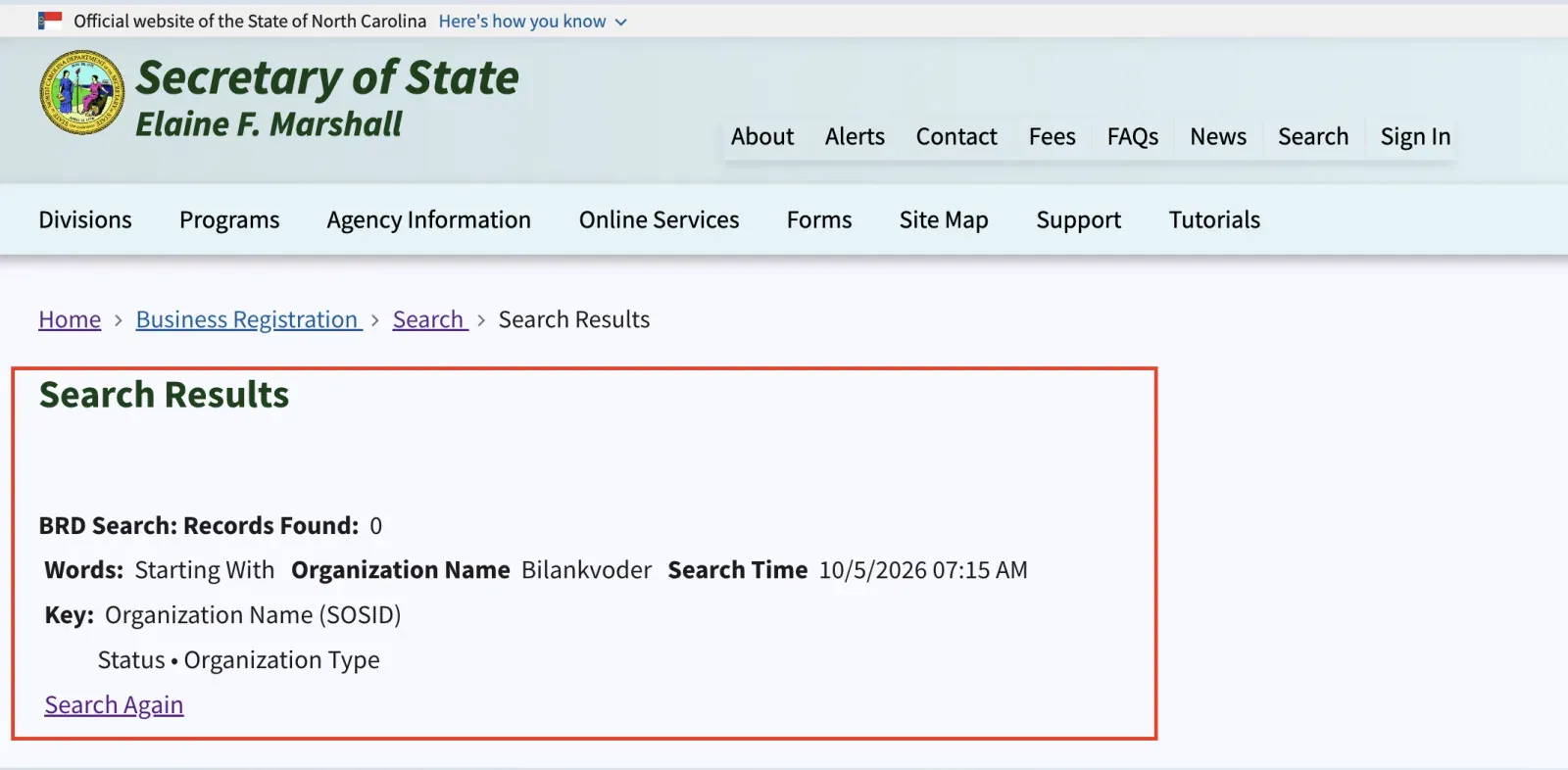
| Why the search came back empty | How to tell | What to do |
|---|---|---|
| Wrong state | The contract, invoice, or website mentions a different state | Find the state of formation and search there |
| Searching by brand name | The invoice or website shows a different legal name | Search by the legal name |
| Wrong registry | The name you are searching is a DBA, or the business is a sole proprietorship, not a company | Check the DBA search. Sole proprietorships are not in the business registry, but one that registered a DBA may show up in the DBA search |
| Search mode | Some forms search by “Starts With” by default, so a word from the middle of the name may return nothing | Search by the start of the name, or choose “Contains” if the form has it |
| Spelling, punctuation, suffix | On some state portals, a comma or the “LLC” suffix can change the result | Drop the suffix and punctuation and search by the first distinctive word of the name |
| The portal did not respond | An error, a timeout, an access block, or a verification screen | Try again later; this is not an answer |
| No such record exists | The six causes above have been ruled out | Only now is it a meaningful signal |
A punctuation difference can look small, but it breaks the search. When I ran exact name matching on a public dataset, “ABC, LLC” and “ABC LLC” did not match.
In my own work I made this distinction a rule: “no record found” is said only when the search really completed. When the source could not be reached, the result is “could not be checked,” and it does not count as clean.
Four purposes the search is used for
For each of the four purposes below, the record tells you something different. The fields to look at change, and so does the question the record cannot answer.
| Task | What to look at in the record | What the record cannot tell you |
|---|---|---|
| Before you pay or sign a contract | Whether the legal name matches the name on the invoice; status; formation date | Whether it can deliver the work |
| Sending a formal letter or serving notice | Full legal name; the registered agent or registered office and its address | Whether the letter will really reach the company |
| A payment or letter you don’t recognize | Whether a company exists under that name, in which state, and whether its address matches the one on the document | That this company sent it |
| Before a partnership or an investment | Status; filing history and documents; other companies registered with the same officer or address | Ownership and financial condition |
In the first row, finding the company’s record is half the job. The other half is establishing that the business in front of you is the company in that record. You know it is when the legal name, state, and record number on your document match the ones in the record. For what that check turned up on 30 active companies in three states, see How to Check if a Company Is Legit.
Free official search, or online services that sell paid reports?
If you only want to check one company in one state, the official search will be enough. The information comes from the source itself.
On the three portals I tested (Pennsylvania, North Carolina, Utah), searching by name was free and did not require an account. The known exception is Texas: the Secretary of State’s SOSDirect system requires an account and charges $1 per search, while the Texas Comptroller’s search is free.
Not everything is free on the official side either. Searching and viewing the record are free. Official output such as a certificate of good standing or a certified copy of a document costs a fee in some states and is free in others. In Wyoming, for example, the certificate of good standing is free.
Paid services that promise bulk search sell convenience. A single search across several states, bulk lookups of many companies, monitoring that alerts you when a status changes, and scattered information gathered into one document are some of the things they offer. For someone who checks many companies on a regular basis, that is a real service.
What a paid service cannot do is produce information the state does not collect. If the state does not record an LLC’s owners, the service cannot find that information in the state’s data either.
The copy can also arrive with less than the source. When I compared one data provider’s responses with the official pages in September 2026, this is what I saw:
| Record | On the official state page | In the data provider’s response |
|---|---|---|
| Kentucky, first company | 31 officer rows and a document list | No officer or document field at all |
| Kentucky, second company | 2 officer rows and a document list | No officer or document field at all |
| Florida, one company | 10 officer rows, 74 document links | 10 officers, 30 documents (on both attempts) |
The provider returned a “success” response for every one of these queries. A successful response showed only that the query had completed. It did not show that the fields had come back filled.
I also tried to build a paid company report on top of these records, and I stopped the work. The part that worked consistently was finding the right record, showing the status, and separating foreign registrations and same-name records. For ownership, lawsuits, and current officer information on private US companies, I could not find a single consistent public source.
| Official state search | Paid report site | |
|---|---|---|
| Cost | Name search was free on the three portals tested; $1 per search on Texas SOSDirect | Per report or by subscription |
| Freshness | The source itself | A copy refreshed at set intervals |
| Multiple states | No, a separate search in each state | Yes |
| LLC owners | Only if the state collects them | The same limit applies |
| Documents | Free and open in North Carolina and Utah; account required in Pennsylvania | May be incomplete |
| Who it is for | One company, one state | Many companies, monitoring |
Short answers about business name search
Is there a national business entity search in the US?
No. The states keep the records, and each state has its own search page. The search has to be done in the state where the company was formed.
Is a business entity search free on state portals?
On the official portal of nearly every state, the name search is free. The known exception is Texas: the Secretary of State’s SOSDirect system charges $1 per search. Official output such as a certificate of good standing or a certified copy of a document costs a fee in some states and is free in others. In Wyoming, for example, the certificate of good standing is free.
Can I find the owner of an LLC (or a company) with this search?
It depends on the state. North Carolina shows registered officials under “Company Officials,” Utah shows them under “Principal,” and the Pennsylvania record I tested lists officers and governors by title. An owner’s name can appear when it was reported to the state and the state does not guarantee anonymity. So the only way to find out is to run a search on that state’s portal.
Can I find the EIN with this search?
No in most states. The IRS issues the EIN, and you get it from the company itself or from a Form W-9. The number you see in the record is the record number the state assigned.
If the status of the entity I looked up says “Active,” can the company be trusted?
No, the word does not say that. “Active” shows that the company was open and active in the state’s records on that date. It does not show that the company is operating, has paid its debts, or can deliver the work. Check separately that the business in front of you is that company, by matching the legal name, state, and record number.