How to Read a Business Entity Search Result: 30 Records Compared
We read 30 active company records in three state registries, field by field. What status, standing, dates and the registered agent address do and don't tell you.
By Muhammet Dikyurt Published
When you open a company record, you see six or seven fields: status, a date, the registered agent, an address, a list of documents. Most guides give one definition for each of these fields.
We read the records of 30 active companies in the official registries of three states, field by field. A field with the same name did not say the same thing on all three portals, and some fields did not exist in one state at all. This page covers what each field tells you, what it doesn’t, and the record where we saw it.
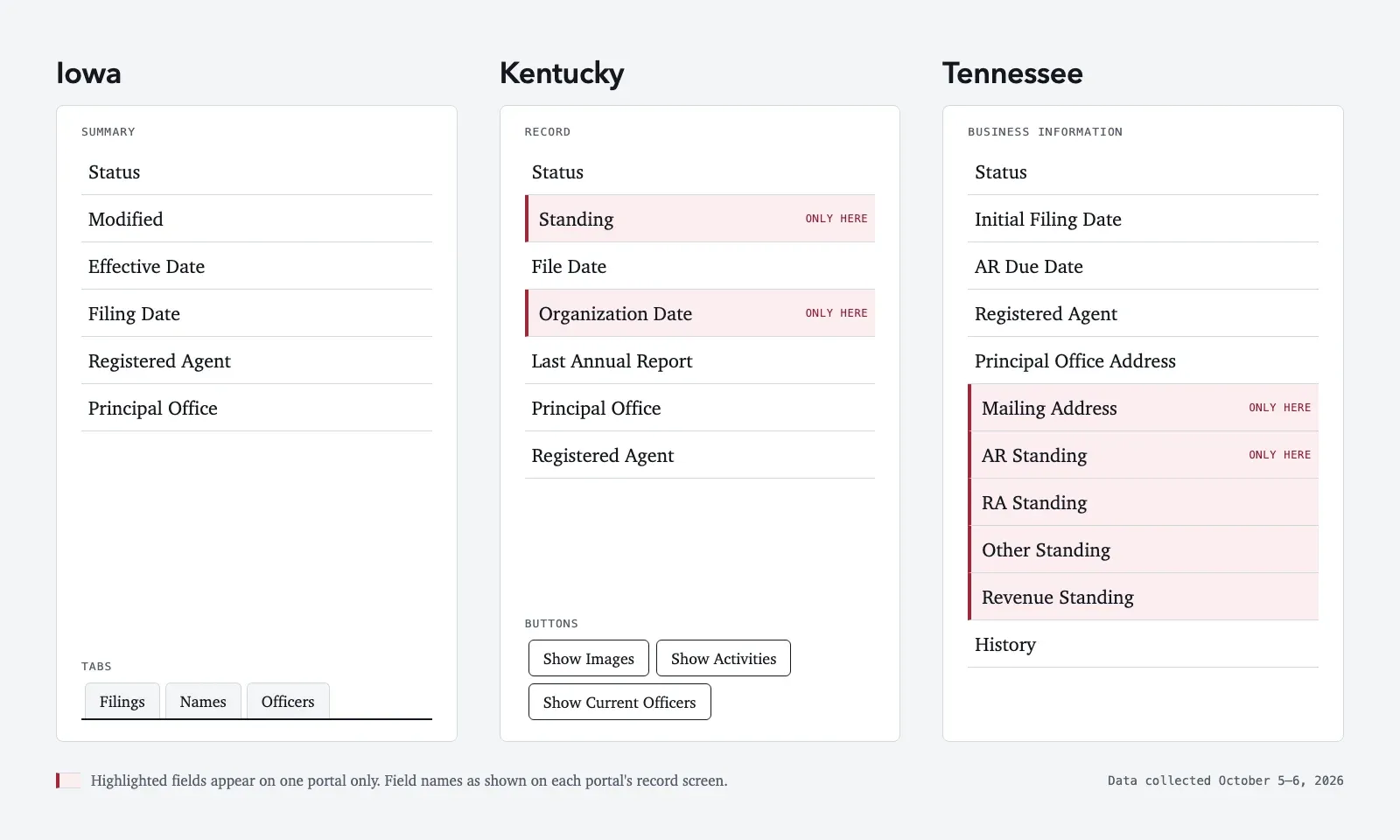
Short answer: what each field tells you, and what it doesn’t
| Field | What it tells you | What it doesn’t | What changes from state to state |
|---|---|---|---|
| Status | Whether the company is open in the state’s records today | How long it has had that status; whether its obligations are up to date | The words used, and how many there are |
| Standing | Where one specific obligation stands (annual report, agent, tax) | The company’s financial condition or how it does its work | Whether the field exists; whether it is one line or four |
| Date | The day a document was filed or took effect | How long the business has been operating | Which date is shown and what it is called |
| Registered agent | Who official notices go to, and where | Who owns the company or where its place of business is | Nothing; all three portals have it |
| Principal office address | The address the company reported to the state | That there is a place of business at that address | Whether there is a separate mailing address field |
| Document list | What was filed with the state, and on what date | That the list is complete; what the document says | Whether the document itself can be opened |
Each row of the table is a section below. If you don’t know which record to open or which state to look in, start with the main guide to business entity search.
What does the status word mean?
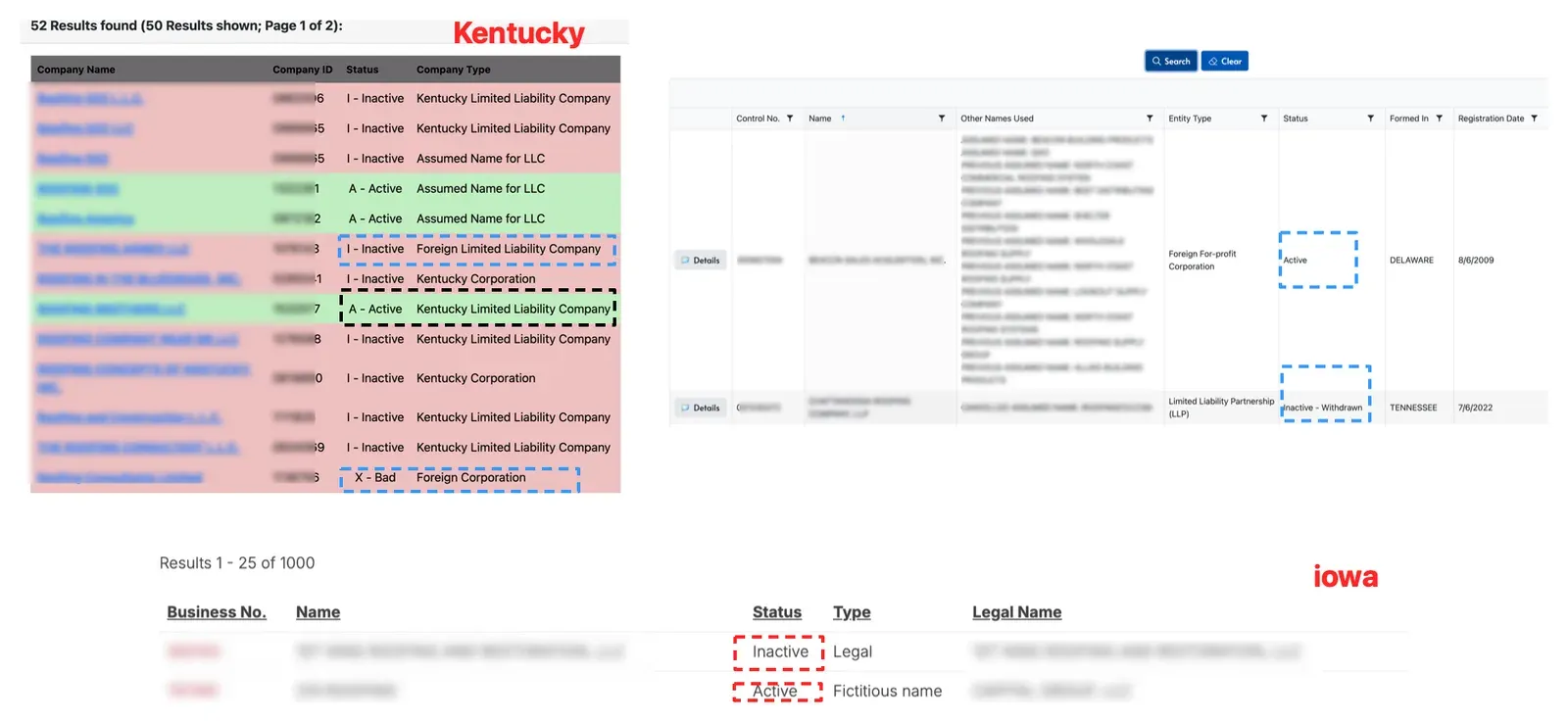
The status word comes from the state’s own vocabulary, and we saw three different vocabularies on the three portals.
| State | Status words we saw in the list and in the record |
|---|---|
| Iowa | “Active,” “Inactive” |
| Kentucky | “A - Active,” “I - Inactive,” “X - Bad” |
| Tennessee | “Active,” “Inactive - Dissolved (Administrative),” “Inactive - Withdrawn” |
Three things stood out.
- Tennessee writes the reason into the status. Next to the word “Inactive,” it also says why the company is not active: administrative dissolution or withdrawal. In the Tennessee list we read on our first search, four of the five inactive rows were administrative dissolutions and one was a withdrawal.
- Kentucky has a third word. We saw the “X - Bad” status on three rows in total across two searches. The portal’s FAQ page does not define this word. What the page describes is “bad standing” on a company with “inactive” status: the company did not file its annual report for the year, or the registered agent resigned and a new one was not appointed. According to the page, companies in that position will be administratively dissolved.
- “Delinquent” was not a status in these three states. Other states use this word as a status. In the 30 records we looked at, it appeared only in the filing history, in the “Delinquent Annual Report” notices in the history of two Tennessee companies. Both companies had the status “Active.”
The general glossary of status words is in the main guide, under Status words change from state to state.
If it says “Active,” is the company in good standing?
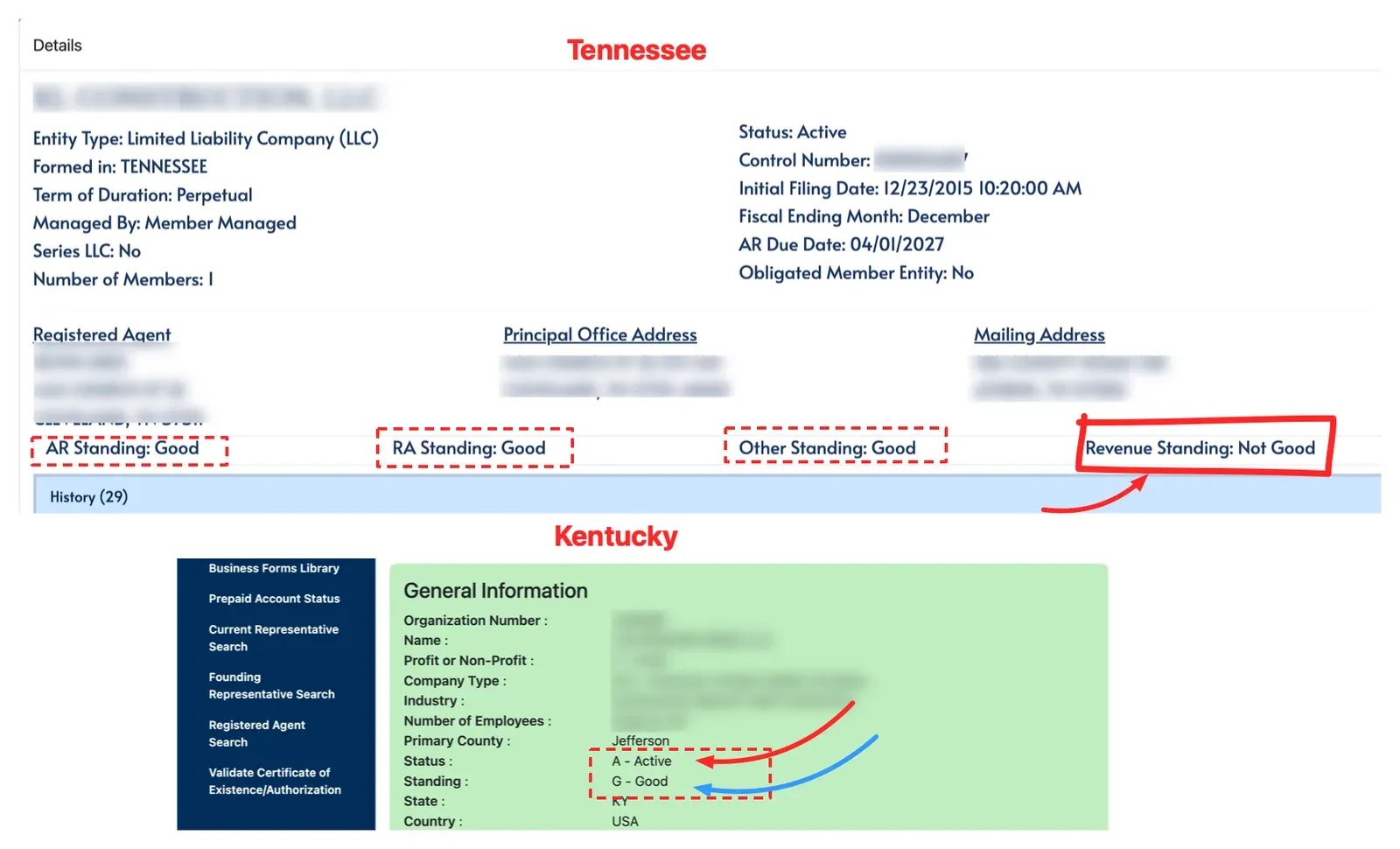
No. Status and standing are separate fields, and not every state shows both.
| State | How standing appears |
|---|---|
| Iowa | We did not see a separate standing field on the record screen |
| Kentucky | One line next to the status: “Standing: G - Good” |
| Tennessee | Four separate lines: AR Standing, RA Standing, Other Standing, Revenue Standing |
In the Iowa records we looked at, we could not find a standing field on the Summary screen. In all 10 of the Kentucky records we looked at, standing was “G - Good.”
In Tennessee, the four lines are independent of each other. In two of the records whose history we looked at, the status was “Active,” three lines said “Good,” and “Revenue Standing” said “Not Good.” The portal does not explain what that line means.
In one of those records we saw something more. The company’s history held delinquent annual report notices two years in a row, and the “AR Standing” line said “Good.” A standing line shows today; it does not show a past delinquency.
None of these lines is a verdict on a company by itself. What they tell you is that after you see the word “Active,” there is a second field to look at, and that not every state has it.
What is the date on the record: a formation date or a filing date?
The dates on a record are the dates of documents. They do not directly give you the age of the business or the day its status changed.
| State | Date shown for formation | Status date | Other date fields |
|---|---|---|---|
| Iowa | “Effective Date” and “Filing Date” on the Summary; in the records we saw, both were the date of the formation document | No separate field | The filing date and effective date of each document on the Filings tab |
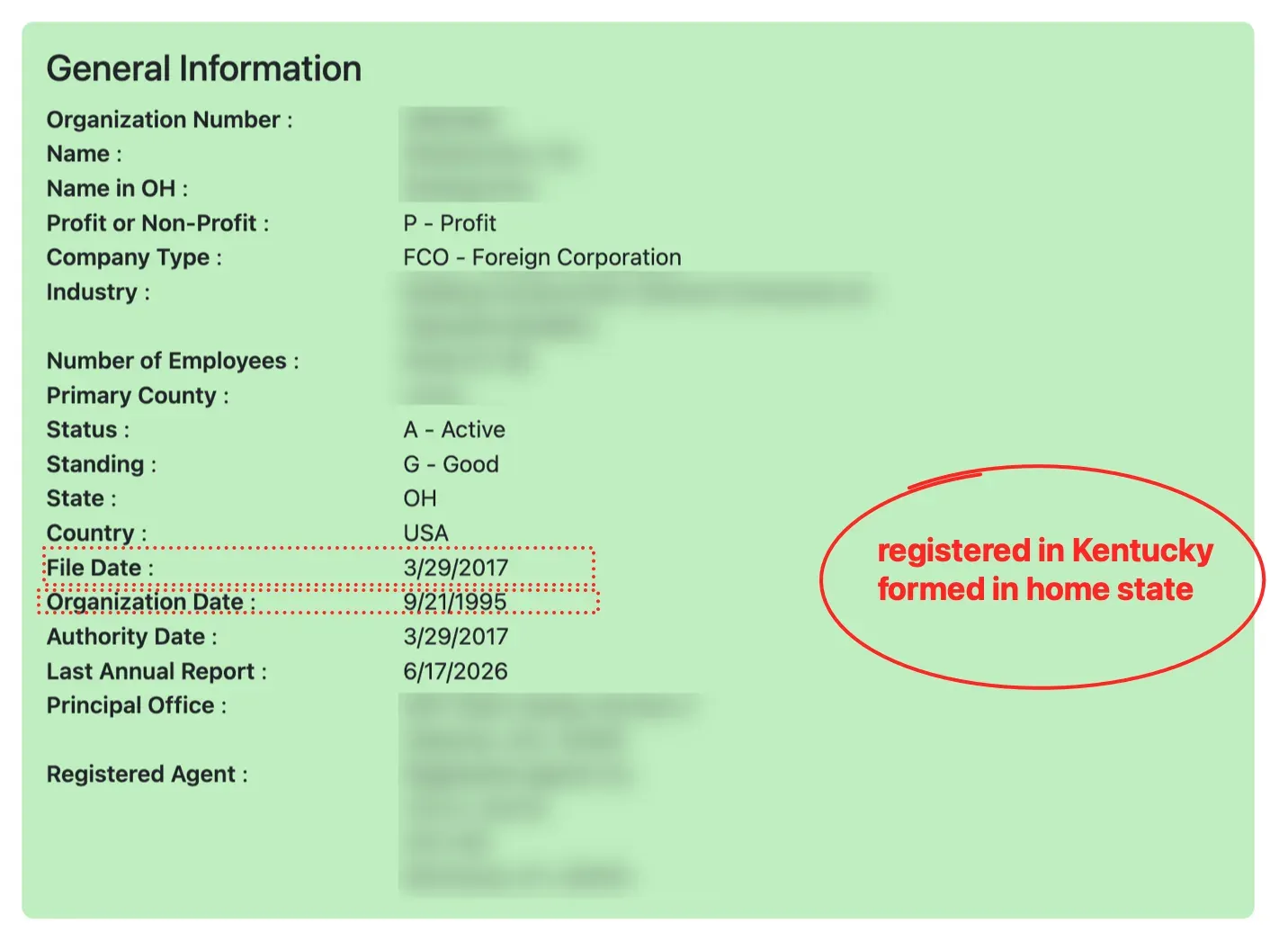
| Kentucky | “File Date” and “Organization Date,” two separate fields | No separate field | “Last Annual Report” |
| Tennessee | “Initial Filing Date” | No separate field | “AR Due Date”; the dates in the History list |
Behind this table are five cases we saw.
The status had no date on any of the three portals. There is no date next to the word “Active” or “Inactive.” To learn how long the company has had that status, you have to open the history list and find the last status change yourself. It is usually on the history tab.
For a company formed in another state, the date may be the date it registered in this state. A Kentucky record for a company with a foreign registration had two dates: “Organization Date” 1995 and “File Date” 2017. The first is the company’s formation in its own state; the second is its registration in Kentucky. In the same state, another foreign company’s record had no formation date at all, only the date of its registration in Kentucky. The foreign-registered company in Iowa was the same. Someone who looks only at that date can take a company that is decades old for a newly formed one.
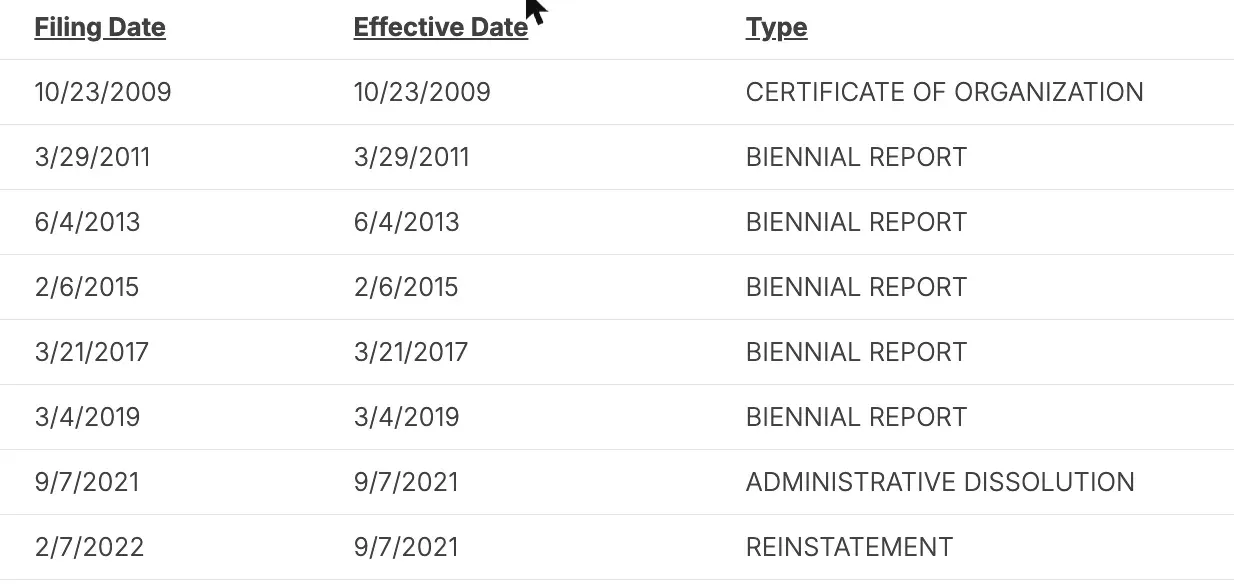
The “Effective” date can be earlier than the filing date. In Iowa, two companies were reinstated months after being administratively dissolved. In both, the effective date of the reinstatement document was the day of the dissolution, not the day the document was filed. Retroactively, the record appears unbroken; in between, there were months when the company was not open in the state’s records.
One record can give two different formation dates. In Tennessee, there was a one-month gap between the “Initial Filing Date” at the top of a record and the first filing row in its History list.
The data has a date of its own. The Tennessee portal states, above the results, the day through which the data has been processed. On the day we looked, the banner said the data was as of October 5 and covered filings processed through October 1: a four-day gap. We did not see a banner like this on the other two portals.
Mixing up dates is not only a human error. We once tried a tool that read company records automatically and wrote a summary. The tool asked for the date each officer took office, and the sources mostly gave the date of the document or of the signature. Of the 50 officer dates we checked, we had to remove 25 from the report for that reason. The same question applies to a date you see next to a name in a record: is it the day this person took office, or the day of the document that names them?
Is the registered agent address the business address?
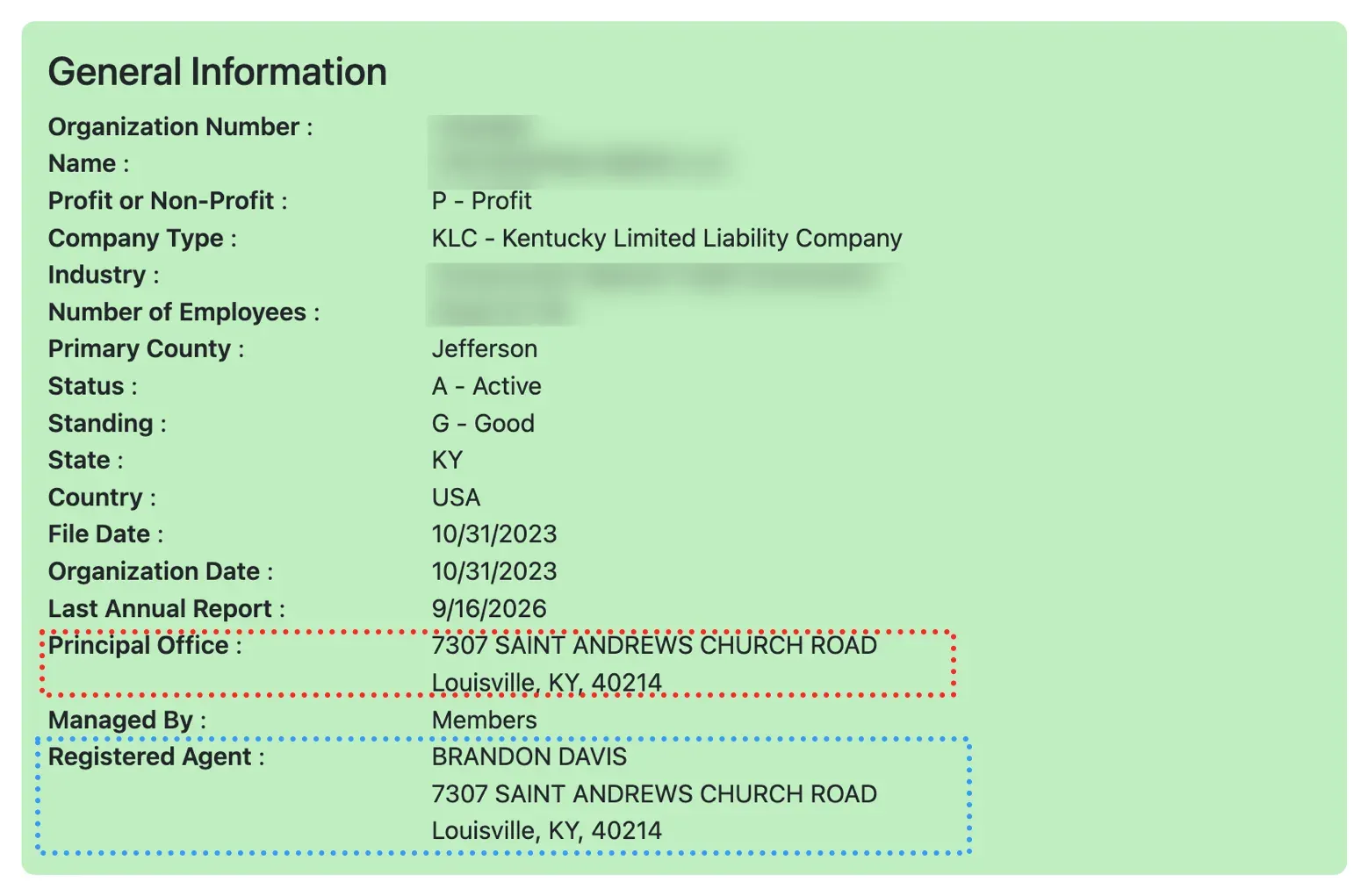
Sometimes yes, sometimes no. It depends on who the agent is.
In the 30 records we looked at:
| Registered agent | Records | Agent address same as principal office address |
|---|---|---|
| A person | 23 | 17 |
| A company (most of them commercial registered agents) | 7 | 0 |
When the agent was a person, the address was usually the company’s own. That was the case in 17 of the 23 records; in the other six, the agent had given a different address.
When the agent was a company, the address was not the company’s address in any record. Six of the seven agents were commercial registered agents that do this as a business; one was an accounting firm. That address is the agent’s office, and a commercial agent uses the same address for a large number of companies. If this is the only “address” you see for a company, you have not yet learned where the company is.
A note on the word “same”: the portals store an address the way it was typed. In some of the records we counted as the same, the two lines were not identical letter for letter. One was missing a suite number, in one the last four digits of the ZIP code were different, and in one “Street” was abbreviated on one line and spelled out on the other. One record had a typo in the city name on the agent line. When you compare two addresses, look at the street number and the street; a difference in format does not mean a different address.
We saw a similar picture in a larger sample. In earlier work, we took 408 company records from a third-party data source. In 74 of them the company address was the same as the agent address; in 176 there was no company address at all, only the agent address. If a tool or site that shows these records labels the field “Business address,” the reader will take the agent’s office for the company’s address.
Whether the registered agent owns the company is a separate question; see Seeing who owns the company.
What does the principal office address show, and how is it different from the mailing address?
The principal office address is the address the company reported to the state. The state does not check whether there is a place of business at that address.
In the records we looked at, we saw four different cases behind this field. They can overlap, and they do not add up to all 30 records:
| What we saw in the record | In how many records | How to read it |
|---|---|---|
| The address is the same as the registered agent address | 17 of 30 | If the agent is a person, usually the company’s own address |
| The company was formed in another state (foreign registration) | 4 of 30 | The principal office can be in this state or in the state of formation; check the state in the address separately |
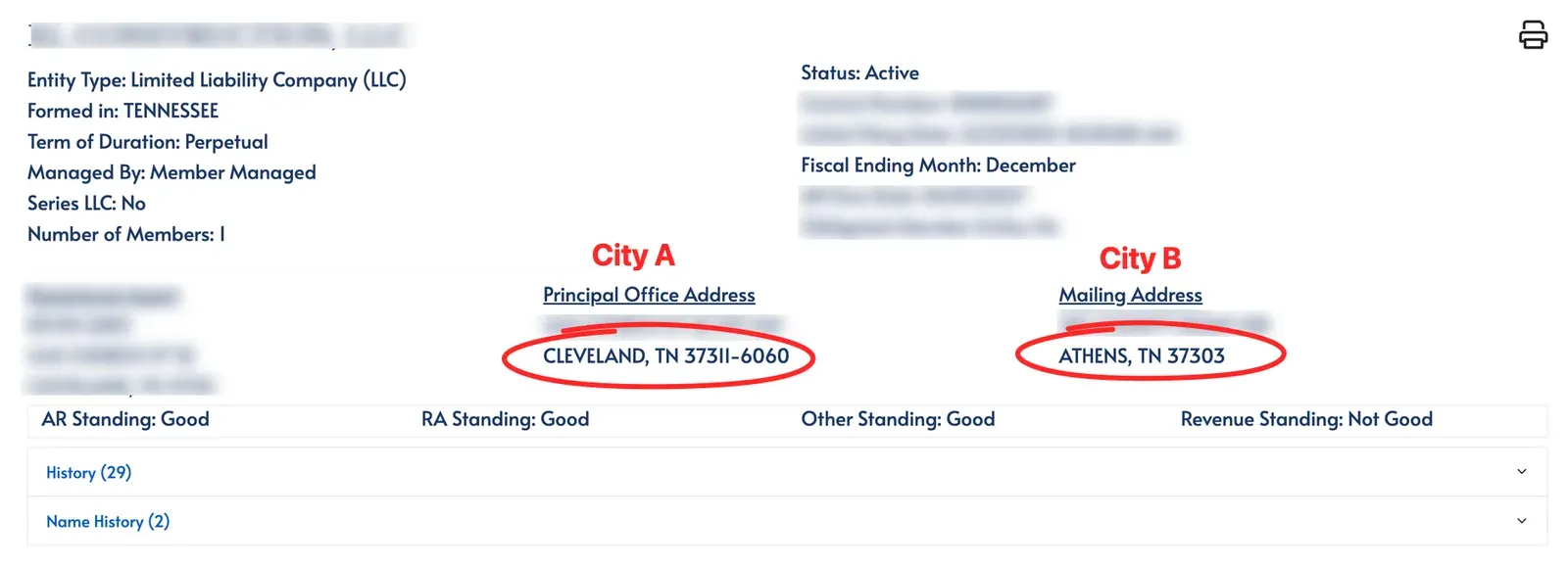
| There is a separate mailing address, and it is in a different city | 1 record in Tennessee | The mailing address is not the business location; Tennessee shows the two separately |
| The address has an apartment number | 1 record | Ordinary for small businesses; it does not show there is no place of business |
Of the three portals, only Tennessee showed the principal office address and the mailing address in separate fields. The other two had a single address.
In one record we ran into three versions of the address: the principal office address in the registry, the mailing address in the registry, and a third address on a directory site. A directory site may cite the registry as its source and still take the address from somewhere else, so make the comparison against the field in the registry.
Whether the address matches the one on the company’s website is a separate check; see the comparison of websites and records.
Is the document list complete, and can I open the documents?
The list varies by state, and we did not measure whether it is complete. What we saw is that the portals give access to the documents in different ways.
| State | Where the history is | The document itself | Known limit |
|---|---|---|---|
| Iowa | The “Filings” tab | PDF, free, no login | No permanent link to the record; a temporary verification page on requests made in quick succession |
| Kentucky | The “Show Activities” and “Show Images” buttons | PDF, free, no login | The reasons for actions are written as abbreviations |
| Tennessee | The “History” section | No image; only the list of filings | Some entries have a type name but no detail text |
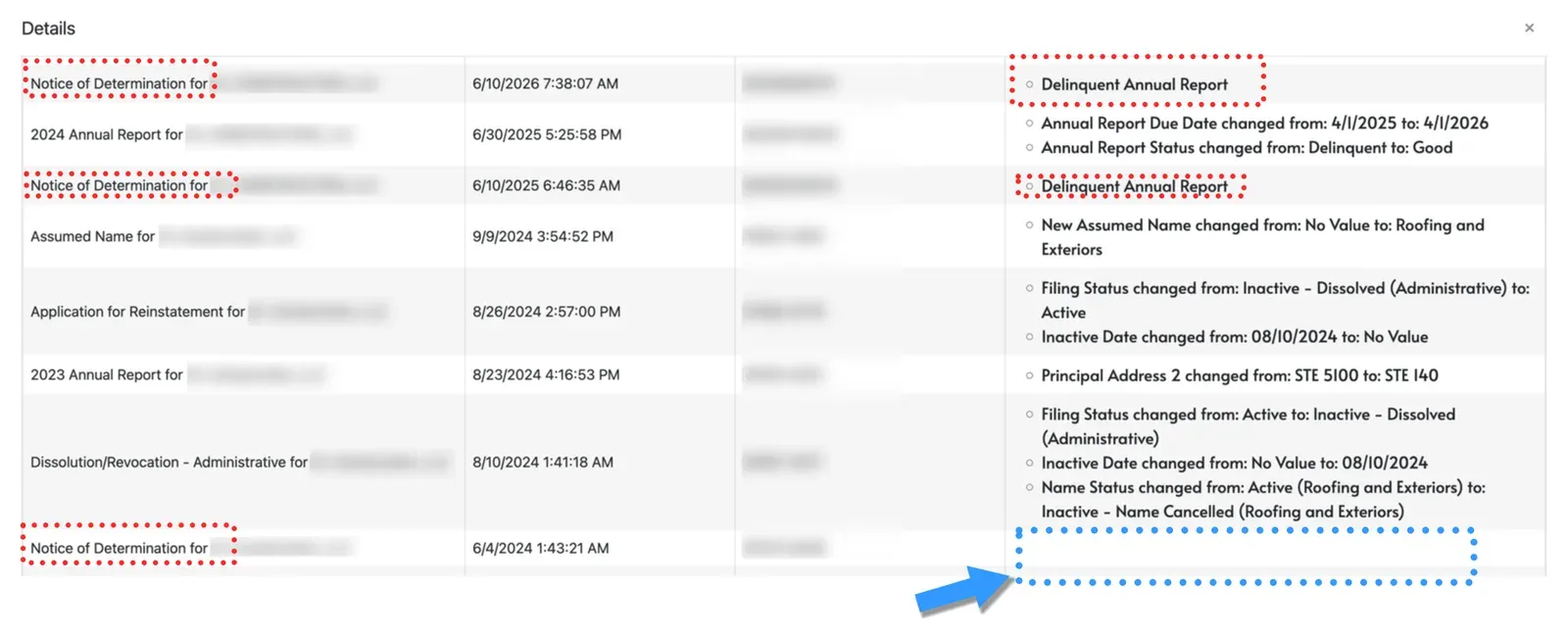
In practice, the Tennessee limit works like this. One record’s history had six notices with the same name. On the last two, the type of notice was written; on the four before them there was only the title. Because we could not open the document, we could not find out what those four notices were about.
If you read the list through a third-party source, one more limit is added. We measured that on Florida and Kentucky records; see Free official search, or online services that sell paid reports? in the main guide.
Can software read this record for you?
It can find the field, but most of the time it cannot know what the field means in that state.
Each difference on this page is a separate rule for an automated reader: Tennessee’s four standing lines, Kentucky’s two dates, the standing field that Iowa does not have at all. Fit them into one template and the difference disappears.
We saw this in numbers in our own trial. We compared 236 claims in four automatically written company reports, one by one, against the source quote.
- The quote fully supported 144 of them.
- In 85, the main fact was right but one detail was not in the source: a date, an agency name, a title.
- The remaining seven were unsupported or contradicted the source. The errors were not in the big claims but in the small fields this page is about.
If you look up a company through an AI application or a paid application (a company registry research app, for example), check the answer against the fields on this page. Is the status word the same as the word in the registry? Which document does the date belong to? Whose address is it?
In what order should you read a record?
| Order | Field to look at | Question to ask | Why |
|---|---|---|---|
| 1 | Status | What exactly is the word, and how many status words does this state have? | We saw three different vocabularies on the three portals |
| 2 | Standing | Does this state have a standing field, and if so, do all the lines say the same thing? | In two records the status stayed “Active” while one standing line said “Not Good” |
| 3 | History list | When was the last status change? | The status date is not a separate field on any of the portals |
| 4 | Date | Is this the formation date or the date of registration in this state? | On foreign-registered records only the second may appear |
| 5 | Registered agent | Is the agent a person or a company? | When the agent was a company, the address was not the company’s own in 7 of 7 records |
| 6 | Address | Are the principal office address and the mailing address separate, and which state are they in? | The address field shows a reported address, not a place of business |
This order is for understanding the record. Whether the company in the record really is the business in front of you is a separate check.
How we measured
- Dates: October 5-6, 2026.
- Sources: The official business search pages of Iowa, Kentucky, and Tennessee.
- Sample: 10 from each state, 30 active companies in total, picked by a fixed rule from two searches related to roofing and plumbing work. The selection rule and the comparison of the same companies with their websites are on a separate page, under How we measured.
- Fields read for this page: status, standing, formation and registration dates, registered agent type and address, principal office and mailing address, history list.
- Collection: The data was collected step by step in a browser, with an AI assistant.
Known limits:
- Thirty records and three states. Fields and words are different in other states; this page is not a state-by-state glossary.
- All the companies in the sample were active. We saw the fields of inactive records only in search lists; we did not read them on record screens.
- We could not find an official definition of the standing lines in Tennessee or of the “X - Bad” status in Kentucky.
- We did not measure whether the document lists are complete.
- In the address comparison, we counted format differences (suite number, ZIP code extension, abbreviation) as the same address.
This site is not a government agency and does not give legal advice.
Short answers
Is the registered agent address the company’s address?
If the agent is a person, usually yes: in 17 of the 23 records we looked at, the two were the same. If the agent is a company, no: in none of the 7 records were they the same.
Are “Active” and “good standing” the same thing?
No. Kentucky shows them on separate lines, and Tennessee shows standing on four separate lines. In two Tennessee records, the status was “Active” while one standing line said “Not Good.”
Is the date on the record the company’s formation date?
Not always. On the record of a company formed in another state, the date you see may be the date of its registration in that state. In one Kentucky record there were more than twenty years between the two dates.
Can I see how long the company has been “Active”?
Not directly. On none of the three portals we looked at was the status date a separate field; you have to look at the last status change in the history list.